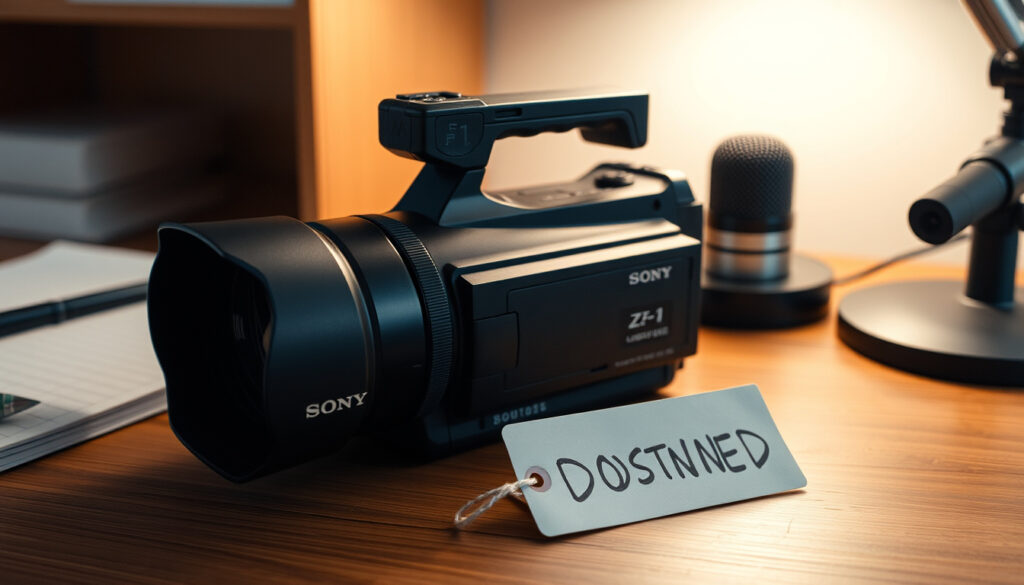
Sony ZV-1 Review (2025): Specs, Discontinued Status & Worth
There’s something reassuring about a camera built for one job—vlogging—that does it well without pretending to be something it isn’t. The Sony ZV-1, launched in June 2020, still holds up in 2025, even as production has wound down in Japan.
Sensor: 1.0-type stacked CMOS (20.1 MP) ·
Lens: ZEISS Vario-Sonnar T* 24-70mm f/1.8-2.8 ·
Video resolution: 4K (UHD) 30p, 1080p 120p ·
Weight: 294 g (body only) ·
Release year: 2020 ·
Production status: Discontinued in Japan (2023), still available via remaining stock
Quick snapshot
- Production ended in Japan in June 2023 (SonyAlphaRumors, photography news site)
- 20.1 MP 1-inch stacked CMOS sensor (PCMag, tech review publication)
- 4K video limited to 30 fps, no 4K 60p (DPReview, camera review authority)
- CIPA-rated battery life of 260 shots, ~40 min continuous 4K (PCMag)
- Whether all regions have officially ceased production or only Japan
- Exact remaining stock in Ireland and the UK
- Future firmware update roadmap
- Whether remaining stock includes all colour variants and accessories
- June 2020: Launch as Sony’s first vlogging compact (PCMag)
- 2022: ZV-1 II launched with wider lens, no ND filter (RTINGS, camera review lab)
- Early 2023: Sony Japan announces end of production (SonyAlphaRumors)
- New stock still available from retailers in 2025, prices around $500-600
- Used market becomes primary source as inventory dries
- Firmware updates expected to continue but not guaranteed
- ZV-1 II and ZV-E10 remain active alternatives
The 10 key facts below show exactly what the ZV-1 packs into its lightweight body. One pattern: it prioritises video ease-of-use over photographic versatility.
| Specification | Value | Source |
|---|---|---|
| Sensor type | 1.0-type Exmor RS CMOS | PCMag |
| Effective pixels | 20.1 MP | PCMag |
| Lens | ZEISS Vario-Sonnar T* f/1.8-2.8 | DPReview |
| ISO range | 125-12800 (expandable to 25600) | PCMag |
| Video recording | 4K UHD 30p, 1080p 120p | DPReview |
| Display | 3.0-inch vari-angle LCD (922k dots) | DPReview |
| Battery | NP-BX1 (260 shots CIPA) | PCMag |
| Weight | 294 g (with battery and memory card) | PCMag |
| Dimensions | 105.5 x 60.0 x 43.5 mm | DPReview |
| Release date | June 2020 | PCMag |
Is the Sony ZV-1 a good camera?
For its intended audience—vloggers who want a compact camera that produces clean video without fiddling—the ZV-1 delivers. DPReview called it “a solid option for vloggers and photographers seeking a compact camera with a fast lens and strong video/still quality.”
What makes the ZV-1 unique for vlogging?
- A side flip-out touchscreen, directional microphone, and background defocus button are all tailored for solo creators (PCMag).
- Sony’s Eye AF and Product Showcase mode switch focus seamlessly from face to object when you hold something up to the lens (DPReview).
- A built-in ND filter (neutral density) lets you shoot wide-open in bright conditions—a feature missing on the ZV-E10 and the newer ZV-1 II (RTINGS).
How does the ZV-1 perform in low light?
The f/1.8-2.8 lens and 1-inch sensor gather enough light for indoor vlogging and evening street shots. DPReview noted that image quality remains usable up to ISO 3200. That’s not match for an APS-C or full-frame camera, but for the size, it’s impressive.
Is the ZV-1 suitable for live streaming?
Yes, with a USB-C connection it works as a UVC webcam without capture cards. PCMag confirmed that after a 2021 firmware update, the camera supports live streaming at 1080p. No 4K streaming, but the video quality is far above any built-in laptop camera.
The built-in ND filter is the ZV-1’s secret weapon. It lets vloggers use f/1.8 in daylight without overexposing—something the ZV-E10 and ZV-1 II cannot do without an add-on adapter.
Is the Sony ZV-1 discontinued?
Yes—at least in Japan. SonyAlphaRumors, a photography news site, reported in June 2023 that Sony Japan had officially stopped production. What that means for global availability is less clear-cut.
When did Sony stop production of the ZV-1?
According to the same SonyAlphaRumors report, the notice came from Sony Japan in early 2023. Other regions may have continued production longer, but no official cross-region timeline exists.
Can I still buy a new Sony ZV-1?
Yes. Retailers in Europe and North America still list new units in 2025. A 2025 video review on YouTube (creator tech channel) reported a new price around $650. In Ireland, stores like Conn’s Cameras occasionally have stock.
Are there firmware updates still available?
Sony continues to offer software updates and support for existing units. The last major update added live streaming. RTINGS confirms the camera remains compatible with Sony’s Imaging Edge Mobile app.
Because production has ceased, prices on new units may rise once remaining stock is gone. The ZV-1 is a finite-availability product now, not a permanent catalog item.
Is the Sony ZV-E10 better than the ZV-1?
This is the most common fork in the road for Sony creators. The ZV-E10 offers an APS-C sensor and interchangeable lenses; the ZV-1 keeps things compact and simple. Which wins depends on your priorities.
Key differences between ZV-E10 and ZV-1
Seven critical distinctions, one theme: the ZV-E10 trades portability for flexibility.
| Feature | ZV-1 | ZV-E10 | Source |
|---|---|---|---|
| Sensor | 1-inch (20.1 MP) | APS-C (24.2 MP) | DPReview |
| Lens | Fixed 24-70mm f/1.8-2.8 | Interchangeable (E-mount) | PCMag |
| Weight (body only) | 294 g | 343 g | PCMag |
| Built-in ND filter | Yes | No | RTINGS |
| 4K 60p | No (max 30p) | No (max 30p) | DPReview |
| Image stabilization | Optical SteadyShot | Electronic (crop) | DPReview |
| Battery life (CIPA) | 260 shots | 440 shots | PCMag |
Which offers better video quality?
The ZV-E10’s larger sensor captures more detail and performs better in low light. PCMag praised its “excellent 4K video” and “best-in-class autofocus.” But the ZV-1’s built-in ND filter and better onboard mic give it an immediate edge for run-and-gun vlogging.
Which is more portable for vlogging?
The ZV-1 slips into a jacket pocket—294 g versus the ZV-E10’s 343 g without a lens. Add a kit zoom lens and the ZV-E10 setup weighs nearly 600 g. DPReview described the ZV-1 as “easily pocketable.” If you vlog on foot all day, the ZV-1 is the lighter burden.
The ZV-E10’s electronic stabilization crops the image noticeably. The ZV-1 uses optical SteadyShot, so you keep the full frame. For vloggers who want to stay wide, the ZV-1 is actually more stable in practice.
The ZV-1 remains a strong contender in the compact vlogging space, but each alternative offers a different trade-off in lens flexibility, stabilization, or portability.
Can I use the Sony ZV-1 for photography?
Yes—for casual, travel, and social media photography it works well. But it’s not a replacement for a dedicated stills camera.
What are the camera’s photo capabilities?
- 20.1 MP RAW capture with Sony’s colour science (DPReview).
- Multiple scene modes, including Portrait, Sports, and Macro.
- Continuous shooting up to 24 fps at full resolution.
How does it compare to a dedicated stills camera?
The ZV-1 lacks an electronic viewfinder (EVF), has limited manual control ring, and no hot shoe for an external flash. PCMag noted that “serious photographers will miss the viewfinder and external controls.” It’s a vlogging-first camera that happens to take good photos.
Is the ZV-1 good for travel photography?
Absolutely. The compact size, wide zoom range (24-70mm equivalent), and fast lens make it ideal for street and travel. DPReview called it “a very capable travel companion.”
Is Sony ZV-1 worth buying in 2025?
Value has shifted. The ZV-1 launched at $800; in 2025 prices have dropped to $500-600 new and around $400 used. A 2025 YouTube review said the ZV-1 “is still a great camera,” while another 2024 long-term review argued that if you already have a decent smartphone, the upgrade is less compelling.
What is the current price of a new ZV-1?
Retail prices hover around $550-650 new in Europe. Used units from reputable sellers start at $400. A 2025 ZV-E10 video review mentioned that even the ZV-E10 can be found used for around £400 in the UK—making both cameras price-competitive.
Should you buy a ZV-1 or the newer ZV-1 II?
The ZV-1 II has a wider 18mm equivalent lens but drops the ND filter and some video features. RTINGS notes it is a “replacement” but not an upgrade in every dimension. If you shoot outdoors in bright light, the original ZV-1’s ND filter is a real advantage.
Is the ZV-1 still a good investment?
For a beginner vlogger who wants a dedicated camera under $600, it’s still a strong pick. Alibaba Electronics, an online marketplace guide, notes that entry-level creators who prioritise 4K/30p video, flip-out screen, and mic input will find the ZV-1 very capable—just be aware it’s a fixed-lens dead-end.
Buying a discontinued camera means no future feature additions. But the ZV-1 already has everything a casual vlogger needs. The real risk is not performance—it’s long-term repair availability.
Sony ZV-1 specs and battery life
Two specs define the user experience more than any other: the NP-BX1 battery and the lack of a viewfinder.
Detailed specifications of the ZV-1
Twelve specs that cover the essentials:
| Specification | Detail | Source |
|---|---|---|
| Sensor | 1.0-type Exmor RS CMOS | PCMag |
| Effective pixels | 20.1 MP | PCMag |
| Lens | ZEISS Vario-Sonnar T* f/1.8-2.8 | DPReview |
| Focal length (equiv.) | 24-70 mm | DPReview |
| ISO range | 125-12800 (25600 expanded) | PCMag |
| Shutter speeds | 30-1/32000s (electronic) | DPReview |
| Max video | 4K UHD 30p, 1080p 120p | DPReview |
| Audio | Built-in directional mic + 3.5mm mic input | PCMag |
| Connectivity | USB-C, micro HDMI, Wi-Fi, Bluetooth | PCMag |
| Battery | NP-BX1 (260 shots CIPA) | PCMag |
| Dimensions | 105.5 x 60.0 x 43.5 mm | DPReview |
| Weight | 294 g (with battery & card) | PCMag |
Battery life in real-world vlogging
The NP-BX1 battery is rated for 260 shots CIPA. Continuous 4K recording lasts about 40 minutes. PCMag noted that the battery is “the camera’s weakest point” for all-day shooting.
How to extend battery life
- Use Power Save mode and lower the LCD brightness.
- Record in 1080p when you don’t need 4K.
- Carry two spare NP-BX1 batteries—cheap and compact.
- Plug into a USB power bank while recording (USB-C supports charging and recording simultaneously).
What are the alternatives to the Sony ZV-1?
The compact vlogging segment has several contenders. Three stand out depending on your priorities.
Sony ZV-1 vs Sony RX100 series
The RX100 VII has a longer zoom (24-200mm equivalent) and an EVF, but costs nearly $1,000. The ZV-1 is lighter, cheaper, and has a better built-in mic. DPReview says the ZV-1 is “the better choice for vloggers, the RX100 for photographers.”
Sony ZV-1 vs ZV-1 II
The ZV-1 II swaps the 24-70mm lens for a fixed 18mm wide-angle. It loses the ND filter and the built-in vari-angle LCD. RTINGS rates the original ZV-1 higher for overall video quality due to the ND flexibility.
Other vlogging cameras in the same price range
- Canon G7 X Mark III: Similar 1-inch sensor, 4K uncropped, flip-up screen, but no built-in ND filter and older autofocus.
- DJI Osmo Pocket 3: 1-inch sensor, 4K 120p, gimbal-stabilized, but no zoom and a vertical form factor.
- ZV-E10 (body): If you already own E-mount lenses, the ZV-E10 is a more future-proof choice despite the battery penalty.
The ZV-1 remains a strong contender in the compact vlogging space, but each alternative offers a different trade-off in lens flexibility, stabilization, or portability.
Pros and cons of the Sony ZV-1
Upsides
- Excellent 4K video quality for the size (DPReview)
- Fast and reliable autofocus with Eye AF (PCMag)
- Compact and lightweight (294 g) (PCMag)
- Built-in ND filter for outdoor shooting (RTINGS)
- Good audio quality out of the box (DPReview)
Downsides
- No electronic viewfinder (PCMag)
- Limited zoom range (24-70mm equivalent)
- Below average battery life (PCMag)
- No 4K 60p recording (DPReview)
- Fixed lens cannot be upgraded
The ZV-1’s strengths in video and portability are clear, but its limitations in battery and lens flexibility are important to consider.
Timeline of the Sony ZV-1
- : Sony ZV-1 unveiled as a dedicated vlogging compact camera (PCMag).
- : Firmware updates improve AF and add live streaming support (PCMag).
- : Sony introduces ZV-1 II with wider 18mm lens, no ND filter (RTINGS).
- : Sony Japan announces end of production for ZV-1 (SonyAlphaRumors).
- : Remaining stock sold through retailers; used market becomes primary source. Camera still supported with firmware updates.
The timeline shows the ZV-1’s lifecycle, from launch to discontinuation, highlighting its relevance in the vlogging market.
What we know and what we don’t
Confirmed facts
- ZV-1 production ended in Japan in 2023 (SonyAlphaRumors)
- Sensor size: 1-inch, 20.1 MP (DPReview)
- 4K video max 30 fps, no 4K 60p (DPReview)
- Battery life: 260 shots CIPA, ~40 minutes 4K continuous (PCMag)
- Built-in ND filter (absent on ZV-1 II and ZV-E10) (RTINGS)
What’s unclear
- Global discontinuation timeline—whether all regions have officially ceased production or only Japan.
- Exact remaining stock availability in Ireland and the UK—depends on retailer inventory.
- Future firmware updates—though past support consistent, no confirmed roadmap.
- Whether remaining stock includes all colour variants and accessories.
- Long-term resale value as production stops fully.
The balance of confirmed facts and open questions underlines the need for careful checking before buying.
What creators are saying
The ZV-1 is designed for casual videography, easy-to-use with uncompromised video quality.
The ZV-1 covers the classic walkaround range – wide enough for landscapes and architecture.
The vlog camera ZV-1 II lets you frame your shots exactly how you want, thanks to its wide-angle zoom lens.
These quotes reflect the consensus that the ZV-1 remains a strong choice for its intended use.
The Sony ZV-1 is not the newest camera on the shelf, but it remains one of the most thoughtful compact cameras ever built for vloggers. Its built-in ND filter, excellent autofocus, and pocketable size give it an edge that the ZV-1 II and even the ZV-E10 don’t fully replicate. For beginner vloggers in Ireland who want a dedicated camera that just works, the decision is clear: grab a ZV-1 while stock lasts, or invest in a ZV-E10 for future lens flexibility.
youtube.com, youtube.com, therunngun.com, youtube.com, youtube.com
The Sony ZV-1 full specs and vlogging guide offers a comprehensive look at its specifications and vlogging capabilities.
Frequently asked questions
Is the Sony ZV-1 good for beginners?
Yes. The interface is straightforward, the side flip-out screen lets you see yourself, and the Background Defocus button is one tap. PCMag called it “the best vlogging camera for beginners.”
Does the Sony ZV-1 have image stabilization?
Yes, it has Optical SteadyShot that reduces shake without cropping the frame—unlike the ZV-E10’s electronic stabilization which does crop.
What memory card does the Sony ZV-1 use?
SD/SDHC/SDXC cards (UHS-I). For 4K recording, use a U3 or V30 card.
Can you use an external microphone with ZV-1?
Yes, it has a 3.5mm microphone input. DPReview praised the built-in mic as good, but external mics like the Rode VideoMicro plug right in.
Does the Sony ZV-1 have a headphone jack?
No, it lacks a headphone monitoring jack. You’ll need an adapter or monitor via the HDMI output.
How does the ZV-1 compare to a smartphone camera?
A 2024 long-term video review on YouTube argued that if you already have a flagship smartphone, the ZV-1 may not be a big enough leap. However, the optical zoom, ND filter, and professional mic input are still superior to any phone.
Is the ZV-1 weather sealed?
No, the ZV-1 is not weather sealed. Sony does not advertise any moisture or dust protection for this model. Keep it dry.
More related posts
 Demon Slayer Infinity Castle Release Dates 2025-2026
 The Prince of Egypt: Biblical Accuracy, Cast, Kids Guide
 Athletic Club vs Man United: History, Identity & 2025 Clash
 Low Income Apartments Near Me: Social & Affordable Housing
 Question of the Day – Best Prompts for Work, Family and More
 Nivea vs Garnier for Skincare Beginners: Best Starter Brand?
 Ukraine Breaking News Today – Ust-Luga Struck Again, Civilian Deaths Rise
 Home Depot Discount Code: Get 10%, 15% or 20% Off
