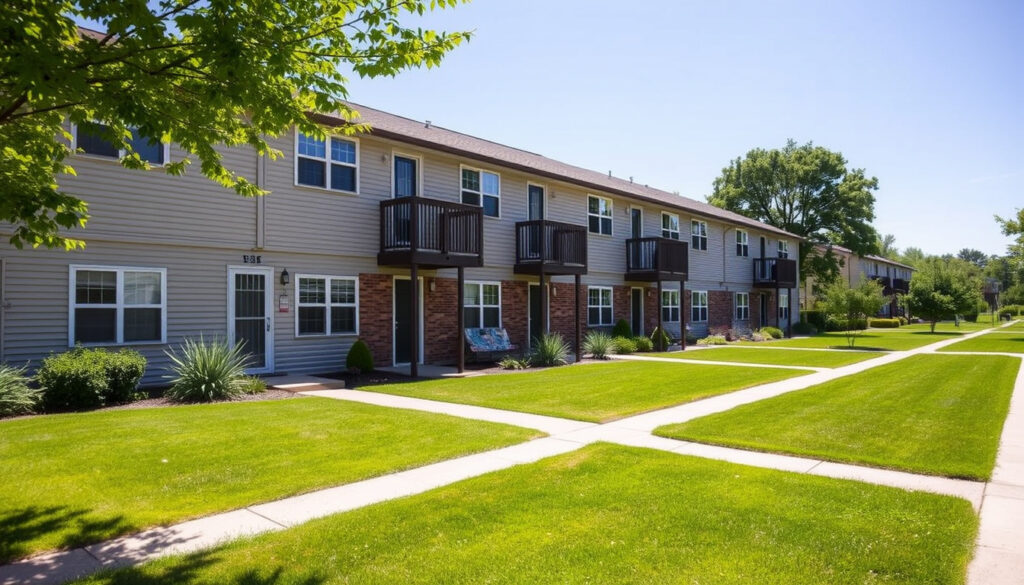
Low Income Apartments Near Me: Social & Affordable Housing
If you’ve spent an evening scrolling through Daft.ie with a sinking feeling, you’re not alone. Ireland’s housing system offers several paths for low-income renters, but telling them apart — council housing, Cost Rental, HAP, affordable purchase — can feel like a second job.
Social housing waiting list (Ireland, 2024): 60,000+ households · Average social rent as % of market: 25-30% · Maximum income for council housing (single, Dublin): €35,000/year · Clúid Housing tenancies: Over 7,000 homes · Lowest average rent county (2025): Leitrim: €650/month · Cost Rental homes target (LDA, 2030): 5,000+
Quick snapshot
- Social rent capped at 30% of household income (Citizens Information – national statutory advisory service)
- Income thresholds set by local authorities, not nationally uniform (Citizens Information – housing rights body)
- Over 60,000 households on waiting lists (2024 data) (gov.ie – Department of Housing statistics)
- Exact waiting times for specific schemes are not published centrally (Citizens Information – housing advisory service)
- Number of new affordable homes per year depends on funding allocations (The Housing Agency – national housing delivery body)
- 2023 – LDA launches Cooper Square Cost Rental scheme (Citizens Information – cost rental guide)
- 2024 – Government expands affordable housing scheme to 18 sites (gov.ie – Department of Housing)
- 2030 – Target delivery of 5,000+ LDA Cost Rental homes (Citizens Information – LDA cost rental)
- LDA targets 5,000+ Cost Rental homes by 2030 (Citizens Information – LDA cost rental)
- Affordable housing schemes are expanding to 18 new sites nationally (The Housing Agency – national delivery body)
- First 15 cheapest places list published (Amber, 2026) (gov.ie – Department of Housing)
Five key numbers tell the story of Ireland’s low-income housing landscape — from waiting lists to rent ratios.
| Fact | Value | Source |
|---|---|---|
| Social housing waiting list households (2024) | 60,000+ | gov.ie – Social Housing Assessment |
| LDA Cost Rental target (2030) | 5,000+ homes | Citizens Information – cost rental |
| Cheapest average rent (Leitrim, 2025) | €650/month | Citizens Information – housing overview |
| Average rent Dublin (2025) | €2,000/month | Dublin City Council – housing authority |
| Social rent as % of market | 25-30% | Citizens Information – social housing |
Who qualifies for affordable housing in Ireland?
Income thresholds for affordable housing
- Single applicant in Dublin: gross annual income must be below €35,000 (Citizens Information – income limits for social housing).
- Couple in Dublin: maximum combined income is €55,000 per year (same source).
- Rural local authorities often set lower caps; for example, Leitrim’s limits are considerably below Dublin’s (Citizens Information – local variation).
Income is only one gate. Even if you earn below the threshold, you also need to prove you cannot meet your housing need from your own resources — meaning you can’t afford market rent or a mortgage.
Household size and priority groups
- Priority goes to homeless households, those living in overcrowded or unfit accommodation, and people with disabilities (Citizens Information – application guide).
- Some councils maintain separate lists for older people or transfer applicants (same source).
- Household size determines the number of bedrooms you qualify for; a single person typically qualifies for a one-bedroom unit (gov.ie – Social Housing Assessment).
The implication: Income limits are just the first filter. Your household composition, current housing condition, and local authority priority bands determine if you actually get an offer.
What is the difference between social rent, affordable rent and market rent?
Social rent definition and examples
- Social rent is set at a maximum of 30% of your household’s assessable income (Citizens Information – rent in social housing).
- This typically works out at 25-30% of the market rent for an equivalent property (Citizens Information – social housing overview).
- Example: a two-bed council flat in Dublin that would rent for €1,800 on the open market may cost a tenant €400-€500 under social rent.
Affordable rent definition and examples
- Affordable rent is typically set at 20-40% below market rates, but higher than social rent (Citizens Information – cost rental guide).
- Schemes are offered by local authorities and approved housing bodies (The Housing Agency – affordable housing delivery).
- Income ceilings are higher: a single person earning up to €35,000 can still be eligible (same as social housing threshold in Dublin).
Market rent current averages
- Dublin average market rent: approximately €2,000 per month in 2025 (Dublin City Council – housing statistics).
- Leitrim average: €650/month, the lowest in the country (Citizens Information – housing overview).
- National average rent is around €1,400/month, putting pressure on low-income households in urban areas.
Social rent is cheapest but hardest to get. Affordable rent is easier to qualify for but still requires below-market prices. Market rent is immediate but often unaffordable without HAP support.
Three rental tiers, one pattern: the more affordable the rent, the longer the queue. The table below shows how they compare on key criteria.
| Criteria | Social rent | Affordable rent | Market rent |
|---|---|---|---|
| Rent level | 25-30% of market (~€400-€500 Dublin 2-bed) | 20-40% below market | Full market price (~€2,000 Dublin 2-bed) |
| Eligibility income (Dublin single) | Max €35,000 | Max €35,000 (some schemes higher) | No income limit |
| Waiting time | 1-7+ years depending on county | Varies; often shorter than social | Immediate |
| Landlord | Local authority or approved housing body | Local authority or AHBs | Private landlord |
| Rent stability | Very stable; capped at 30% income | Stable; reviewed periodically | Subject to market increases |
How long is the waiting list for social housing in Ireland?
Current wait times by county
- Nationally, over 60,000 households are on waiting lists (gov.ie – Social Housing Assessment 2024).
- Wait times vary dramatically: rural counties like Leitrim may see a 1-2 year wait, while Dublin can stretch to 7 years or more (Dublin City Council – housing authority).
- Each local authority publishes its own allocation scheme and priority bands, so there is no single national waiting list (Citizens Information – allocation process).
Factors that reduce wait time
- Priority band (e.g., homeless, medical need) can move you up the list (Citizens Information – priority groups).
- Accepting a property in a less popular area can shorten your wait (Citizens Information – housing advice).
- Applying to multiple local authorities (if you have a housing need in each area) is allowed and can increase your chances.
For a single person in Dublin earning under €35,000, the wait for a council home could be longer than seven years. For a family in Leitrim, it might be one to two years. Your county is the biggest variable.
What this means: Waiting times are not a national number — they are a local reality. Before you pin your hopes on one scheme, check your local authority’s allocation plan and priority bands.
“To qualify for social housing, you must normally have a gross income below the local authority threshold and be unable to meet your housing needs from your own resources.”
Citizens Information advisor – national housing rights service
“Cost Rental homes are offered at cost price, ensuring they remain affordable for middle-income households who earn too much for social housing but not enough to rent comfortably on the open market.”
Spokesperson for the Land Development Agency (LDA) – cost rental delivery body
Quick comparison: social rent vs affordable rent vs cost rental vs HAP
Five pathways, one question: which one gets you into a home fastest? The table below lays out the trade-offs.
| Scheme | Rent level | Income cap (Dublin single) | Typical wait | Who it suits best |
|---|---|---|---|---|
| Social housing (council) | ~30% of income | €35,000 | 1-7+ years | Lowest-income households |
| Affordable rent | 20-40% below market | €35,000 (some schemes higher) | 1-3 years | Moderate-income, can’t afford market rent |
| Cost Rental (LDA & AHBs) | Cost price, below market | None formal, but aimed at middle incomes | 1-3 years | Earn too much for social housing, can’t buy |
| HAP (Housing Assistance Payment) | You pay 30% income, State pays top-up | Same as social housing | Ongoing, not a waiting list | Need immediate help in private rental |
| RAS (Rental Accommodation Scheme) | Similar to HAP, long-term | Same as social housing | Referral from council | Long-term social housing need |
The takeaway: No single scheme is fastest for everyone. If your income is very low and you can wait, social housing gives the best value. If you need a home now, HAP or affordable rent may be your best bet.
Upsides
- Social rent is deeply subsidised; you never pay more than 30% of income.
- HAP allows you to rent privately while receiving state support.
- Cost Rental offers stable, below-market rents with no waiting list priority system.
- Affordable purchase gives a chance to buy below market value.
Downsides
- Social housing waiting lists are very long, especially in Dublin.
- HAP requires a willing private landlord, which is increasingly hard to find.
- Cost Rental homes are still limited in number; supply lags demand.
- Income thresholds are not updated annually in some areas, creating gaps.
How to apply for council housing and other schemes
Step 1: Assess your eligibility
- Check your gross income against your local authority’s limits (Citizens Information – income limits by county).
- Ensure you have a verified housing need (e.g., overcrowding, homelessness, medical grounds) (Citizens Information – application guide).
- Gather documents: photo ID, proof of income, proof of residence, birth certificates for household members (Citizens Information – application checklist).
Step 2: Submit your application
- Apply to the local authority for the area where you have a housing need (Citizens Information – how to apply).
- You can apply to multiple authorities if you have a need in each area.
- If you are homeless or at risk of homelessness, contact your local authority’s housing department immediately for an emergency assessment.
Step 3: Explore alternative pathways
- While waiting for social housing, register for HAP to get support in the private rental market (Citizens Information – HAP guide).
- Check if Cost Rental developments are available in your area through the LDA or approved housing bodies (Citizens Information – cost rental).
- Consider affordable housing schemes through The Housing Agency portal (The Housing Agency – national housing delivery body).
Step 4: Track your application
- Your local authority will assess your application and assign a priority band.
- You can request an update on your position in the allocation scheme (not all councils provide a queue number).
- If your circumstances change (income, household size, address), notify the council immediately to avoid delays.
Timeline: key milestones in low-income housing in Ireland
- 2023: LDA launches Cooper Square Cost Rental scheme – the first large-scale cost rental development (Citizens Information – cost rental launch).
- 2024: Government expands affordable housing scheme to 18 new sites across the country (gov.ie – Department of Housing announcement).
- 2026: First “15 cheapest places” list published by Amber, highlighting affordable rental towns (gov.ie – housing data).
- 2030: Target delivery of 5,000+ LDA Cost Rental homes nationally (Citizens Information – LDA targets).
Related reading: Clothes Donation Near Me: Ireland Banks & Pods Guide · Staffing Agencies Near Me – Top Temp Options in Columbus GA
Related coverage: affordable studio apartments near me fördjupar bilden av Studio Apartments Near Me: No Deposit & Cheap Rentals in Ireland.
Frequently asked questions
What is the difference between affordable rent and social rent?
Social rent is capped at 30% of your household income and is typically 25-30% of the market rate. Affordable rent is 20-40% below market but not tied to your income — it’s a fixed lower price set by the provider. Social rent is cheaper but harder to qualify for; affordable rent is aimed at households that cannot afford market rent but earn above social housing limits.
How do I know my income qualifies for social housing?
Check your local authority’s income limits. For Dublin City Council, the limit for a single person is €35,000 gross annual income. For a couple, it’s €55,000. Limits are lower in many rural counties. Citizens Information publishes a full table by local authority.
Can I apply for both council housing and Cost Rental?
Yes. They are separate schemes. You can apply for social housing through your local authority and also register interest for Cost Rental developments via the LDA or approved housing bodies. Accepting a Cost Rental home may affect your social housing application — check with your council.
What is Clúid housing and who can apply?
Clúid Housing is an approved housing body that provides social and affordable homes across Ireland. Eligibility is similar to council housing: low income, housing need, and local authority referral. Clúid manages over 7,000 tenancies and operates in many counties.
How long do I have to wait for a Cost Rental home in Dublin?
Cost Rental is a relatively new scheme with limited supply. Wait times vary by development and demand. The LDA’s Cooper Square in Dublin had significant oversubscription. Check the LDA website for current availability and upcoming projects.
Is affordable housing in Ireland only for Irish citizens?
No. You do not need to be an Irish citizen to apply for social housing, HAP, or Cost Rental. However, you must have a legal right to reside in Ireland and meet the local authority’s residency rules for the area where you apply.
Where are the cheapest places to rent in Ireland in 2026?
As of 2025, Leitrim had the lowest average rent at €650/month. Other affordable counties include Donegal, Roscommon, and Longford. The “15 cheapest places” list published by Amber in 2026 will give updated rankings for budget-conscious renters.
For low-income renters in Ireland, the choice is not between good and bad — it’s between slow and slower. If you qualify for social housing, apply immediately and also register for HAP to get help in the private market while you wait. For Dublin singles earning under €35,000, the practical path is to stack applications: council housing, Cost Rental waiting lists, and affordable housing schemes simultaneously. The system is fragmented, but the one who applies everywhere first moves in first.
More related posts
 How to Dry Herbs: The Easiest Methods for Every Herb
 Cha e Bank Juneteenth Clo ure 2025: Are Branche Open?
 Armenia–Iran Border: Length, Crossings, and Travel Tips
 Sol de Janeiro 68: Scent, Dupes & Ireland Buy Guide
 Tini Mac and Cheese Recipe: Viral TikTok Hit
 Houston Cougars vs Duke Blue Devils: Player Stats 2025 Final Four
 Greg Biffle Net Worth 2025: How Rich Was He at Death?
 Where to Watch Coraline: Tubi, Roku, Amazon & More
