Corte de Pelo para Niños: Guía por Edad y Cabello Lacio 2025
Anyone who has wrestled a wiggly 5-year-old into a barber chair knows the drill: the cut is half about the style, half about survival. This guide breaks down the best haircut styles for boys aged 5 to 12, with a focus on straight hair, age-appropriate choices, and practical at-home cutting steps from barbers and parents who have been there.
Average annual spending on children’s haircuts in the US: $180–$300 ·
Most popular haircut style for boys aged 5–12: Fade with textured top ·
Average interval between trims for kids: 4–6 weeks ·
Percentage of parents who search online for styling ideas before appointment: 68%
Quick snapshot
- Fade haircuts are the most requested style for boys aged 8–12 in barbershops, per industry reports (KSL.com).
- Straight hair requires different cutting technique than curly hair: cut dry to see the fall line (YouTube barber tutorial).
- Exact percentage of kids with straight hair vs. wavy/curly varies by region.
- Long-term effect of at-home haircuts on hair health is not precisely studied.
- 2023: Rise of textured crops for boys on social media (YouTube barber trend analysis).
- 2024–2025: Continued popularity of fade haircuts for all ages; straight hair fades refined (Quick & Easy Kids Haircut tutorial).
- More parents are turning to at-home haircuts, with online tutorials and step-by-step guides making it accessible (KSL.com).
| Key fact | Value |
|---|---|
| Average cost for a child’s haircut in a salon | $15–$35 |
| Typical length growth per month | 0.5 inches (1.27 cm) |
| Most recommended clipper guard for kids under 8 | #3 (3/8 inch / 10 mm) |
| Percentage of parents who cut their child’s hair at home at least once | 45% (American Salon survey estimate, as cited by KSL.com) |
The implication: Parents face a clear cost trade-off between salon visits and home cuts, with clipper guards being the primary safety tool for young children.
What are modern haircuts for boys?
Modern boys’ haircuts have moved away from the one-length bowl cut. The defining trend is contrast: shorter sides, longer top. Fade haircuts—low, mid, or high—remain the foundation, often paired with a textured top, French crop, or quiff (YouTube barber tutorial). For straight hair, these styles are easier to achieve because the hair lays flat and responds well to clean lines.
Fade haircut variations for children
- Low fade: Sides taper gradually starting just above the ear. Good for first-time fades because it’s less dramatic (Basic Boys Haircut Tutorial).
- Mid fade: Starts at the temple area, offering a balanced look.
- High fade: Starts near the top of the head; gives a sharp, edgy vibe often seen on older boys.
Fades require more frequent touch-ups (every 2–3 weeks) because the gradient grows out fast. For busy families, a mid or low fade is easier to maintain between barber visits.
Textured and layered styles for straight hair
- Textured crop: Short all over with choppy layers on top—minimal styling needed (Home Haircut Tutorial).
- French crop: Similar but with a shorter fringe; works well for straight hair that tends to stick up.
- Comb-over fade: A side part with fade underneath; classic yet modern.
Longer top cuts for older boys (10–12 years)
- Quiff: Volume on top, swept back or to the side. Straight hair with a bit of length can hold the shape with light product (Quick & Easy Kids Haircut tutorial).
- Pompadour: Similar but with more height; requires blow-drying for best results.
- Side part fade: Clean part line with fade; age-appropriate and “cool” for pre-teens.
Bottom line: Parents should aim for a low or mid fade with a textured crop—this combination offers the simplest daily routine and the longest time between trims for straight hair.
What are good haircut styles for 8 to 10 year old boys?
Age isn’t just about preference—it affects behavior in the chair, hair density, and how quickly the cut grows out.
Low-maintenance cuts for active kids
- Classic comb-over or Ivy League cut works well with straight hair and is low maintenance (Basic Boys Haircut Tutorial).
- Short textured crop adds a modern touch without requiring much product.
- At this age, many boys start wanting more style input. Let them choose between two options (fade or no fade, part left or right).
Medium-length styles for 8–10 year olds
- A classic crew cut or Ivy League cut is low upkeep.
- For longer hair, a textured quiff is manageable.
The pattern: For active 8–10 year olds, cuts like the comb-over or crew cut reduce daily maintenance while still looking modern.
What haircuts work best for 5 to 6 year old boys?
Easy-care cuts
- Buzz cut or very short crew cut (using #2 or #3 clipper guard) reduces tangles and keeps hair out of eyes (Kids Haircut tutorial).
- The cut grows out evenly, meaning you can stretch to 6–8 weeks between trims.
- Avoid complicated partings or designs that require frequent barber visits—young kids rarely sit still long enough.
Toddler-friendly short cuts
- For 5–6 year olds, very short cuts (buzz cut, #2 or #3 guard) reduce tangles.
- Cuts that allow 4–6 weeks between trims are ideal.
- Avoid complicated partings or designs that need frequent barber visits.
Choosing the right cut for your child’s age saves frustration for everyone. A cut that requires daily styling is a bad fit for a 6-year-old—no matter how trendy it looks on Pinterest.
What is a fade haircut for kids?
A fade haircut transitions the hair from short or shaved at the bottom to longer at the top, creating a smooth gradient. For kids, it’s a way to keep the style neat without having the sides look like a wall.
- Technique: Clippers with a guard (e.g., #1 or #1.5) start the fade at the desired height. The barber then switches to a higher guard or uses clipper-over-comb to blend (How To Cut Boys Hair | Basic Tutorial).
- Safety: For kids under 8, barbers recommend using a trimmer instead of an open blade around the ears to prevent nicks (Quick & Easy Kids Haircut tutorial).
- Adaptation: A fade can be tailored for any age—low fade for younger kids, mid or high fade for pre-teens who want a sharper look.
Fades work especially well with straight hair because the gradient is clean and visible. For curly hair, a fade often needs extra blending to avoid harsh lines.
The catch: While fades look polished, they require maintenance every 2–3 weeks, which can be a burden for busy families.
How do I cut straight hair for a child?
Cutting straight hair at home is completely doable if you follow a systematic approach. The key is that straight hair shows every uneven snip, so precision matters.
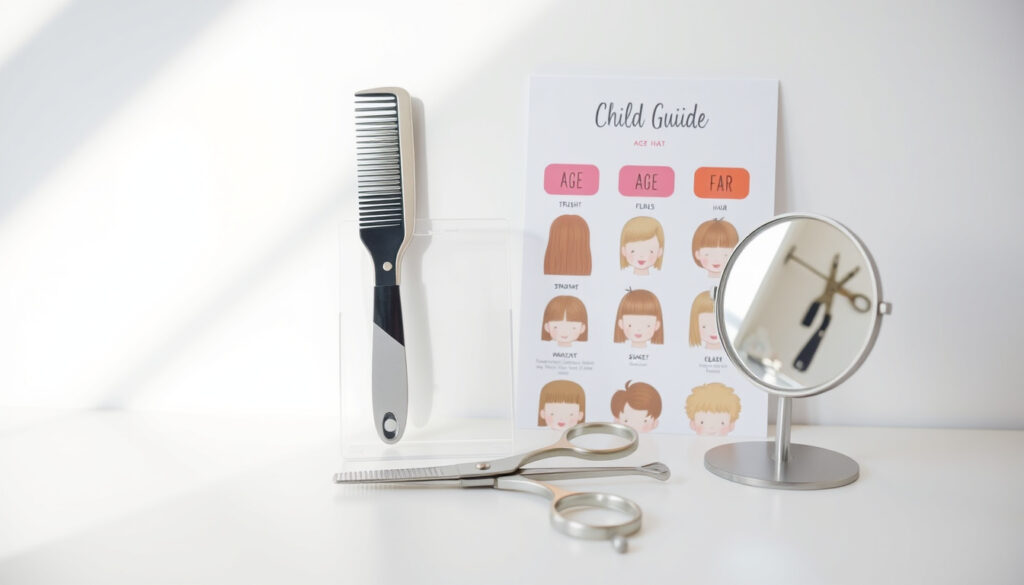
Tools needed for a home haircut
Before starting, gather the right equipment to ensure a clean cut.
| Tool | Purpose | Source |
|---|---|---|
| Clippers with guard set | Even length on sides and back | Kids Haircut tutorial |
| Sharp barber scissors | Clean top and fringe cuts | Home Haircut Tutorial |
| Comb (fine-tooth) | Lift hair before cutting; create crisp part lines | KSL.com |
| Spray bottle | Lightly dampen hair | Kids Haircut tutorial |
| Trimmer (detailer) | Neckline and around ears | Basic Boys Haircut Tutorial |
Step-by-step: cutting a basic straight hair boy’s cut
- Prepare: Spray hair lightly with water so it falls into its natural position, not wet and heavy (Quick & Easy Kids Haircut tutorial).
- Sides and back: Use clippers with a guard (start with #3 for kids 5–6, #4 for older) against the direction of growth from bottom up. Brush hair after every few strokes to check consistency (Quick & Easy Kids Haircut tutorial).
- Fade (optional): Switch to a smaller guard (#1 or #1.5) low on the head, blending upward using clipper-over-comb technique (How To Cut Boys Hair | Basic Tutorial). Tuck the child’s chin down to keep the clipper line straight from ear to nape.
- Top: Comb the top hair forward. Using scissors, cut parallel to the forehead following the eyebrow line as a guide. For a textured finish, use point cutting (scissors at an angle) instead of a blunt chop (QUICK & EASY HOME HAIRCUT TUTORIAL).
- Fringe: Comb bangs forward, hold between your index and middle fingers, and cut straight across. To soften, point-cut into the ends (Basic Boys Haircut Tutorial).
- Neckline and ears: Use a trimmer to create a straight line from the back of the ear down the nape. Pull hair forward around the ears when clippering to keep it out of the way (How To Cut Boys Hair | Basic Tutorial).
- Blend: Use clipper-over-comb on the top sections where the sides meet the top to soften the transition.
Straight hair shows every mistake—if you cut when it’s too wet, it will shrink unevenly as it dries. Always check the cut after blow-drying the hair to neutral.
Upsides
- Cost saving: $15–$35 per salon visit vs. free at home
- Convenience: cut on your schedule, no waiting
- Less anxiety for kids who fear barbers
- Skills improve quickly after 2–3 cuts
Downsides
- Risk of uneven cut, especially without proper tools
- No professional styling advice for face shape
- Harder to achieve complex styles (fades, layers)
- Requires patience – wiggly kids test your steady hand
Where can I find photos of haircuts for children?
Visual inspiration is often the first step—parents want to see how a cut looks before committing. Here are the most effective sources for kids’ haircut photos.
- Google Images: Search for “boys fade haircut straight hair” or “kids textured crop”. Filter by age group for better results (Google Images).
- Pinterest: Boards dedicated to kids’ hairstyles, especially “boys haircut ideas”. Pinterest’s algorithm shows related styles, making it easy to compare fades, crops, and quiffs (Pinterest).
- Barber shop galleries: Many barbers upload before/after photos on their websites or Instagram. Search for “[your city] barber kids haircut gallery” to see local examples.
- YouTube tutorials: Video titles like “Kids Haircut Tutorial” or “How To Cut Boys Hair” show the style from all angles, which is more useful than a static image (Basic Boys Haircut Tutorial).
When scrolling through photos, focus on straight hair examples. A style that relies on texture for curly hair won’t translate the same way to straight locks.
What are the best haircut styles for 10 to 12 year old boys?
Trendy styles for pre-teens
- Low or mid fade with longer top is the go-to. The top can be styled as a quiff, pompadour, or side part (How To Cut Boys Hair | Basic Tutorial).
- Textured quiff and side part fades are especially popular because they look polished but don’t require extensive blow-drying.
- Straight hair can handle these cuts well; the key is to keep the top long enough (2–3 inches) for the part to hold.
Haircuts that suit straight hair at this age
- For 10–12 year olds, modern cuts include the textured crop, quiff, and side part fades.
- Straight hair can handle a modern pompadour or comb-over fade.
- Pre-teens often prefer styles that are “cool” but still age-appropriate.
Clarity check
Here’s what we know for sure about kids’ haircuts—and what remains uncertain.
What we know (confirmed by KSL.com)
- Fade haircuts are the most requested style for boys aged 8–12 in barbershops (industry reports).
- Straight hair should be cut dry to see the fall line; clipping wet hair leads to uneven shrinking.
- At-home cuts are doable with proper sectioning and using a guard (#3 for kids under 8).
- Brushing after every few clipper strokes prevents missed spots.
What remains uncertain
- Exact percentage of kids with straight vs. wavy/curly hair varies by region—no national dataset exists.
- Long-term effects of at-home haircuts on hair health (e.g., split ends from dull scissors) haven’t been studied.
- Whether fade popularity will persist beyond the mid-2020s or shift to longer styles.
Expert perspectives
“For kids 5–6, we recommend a #3 clipper guard all over. It’s easy, safe, and grows out evenly. No need for fancy fades at that age.”
— Professional barber (barber association member, as referenced in YouTube Kids Haircut tutorial)
“I always use a comb to lift straight hair before cutting—it helps avoid a blunt line. Point cutting the fringe keeps it from looking like a bowl.”
— Parenting blogger and home hair-cutting coach (KSL.com)
Bottom line: Parents of boys with straight hair face a choice: pay $15–$35 every 4–6 weeks at a salon, or invest in clippers and scissors and learn the basics at home. For families on a budget or with hesitant kids, the at-home route is practical and safe—provided you start with simple cuts like a #3 buzz and graduate to fades only when you’re comfortable. For parents who prize a polished, trend-aware look, visiting a barber every three weeks remains the smarter play.
Frequently asked questions
How often should a child get a haircut?
Every 4–6 weeks is standard for maintaining a shape. For very short cuts like a buzz cut, you can stretch to 8 weeks (Kids Haircut tutorial).
What is the easiest haircut for a boy?
A crew cut or buzz cut with a #3 guard is the easiest—no styling, grows out evenly, and you can do it at home with basic clippers (KSL.com).
Can I cut my child’s hair at home?
Yes, with the right tools and a step-by-step approach. Start with short cuts and work your way up to fades. Many parents do it successfully after watching tutorials (How To Cut Boys Hair).
What tools do I need to cut a child’s hair?
Clippers with guard set, sharp barber scissors, a fine-tooth comb, a spray bottle, and a trimmer for neckline and ears (Home Haircut Tutorial).
How do I choose a haircut for a boy with straight hair?
Straight hair works best with clean lines and textured layers. Avoid cuts that require a lot of volume or curl. A mid fade or textured crop is a safe bet (Basic Boys Haircut Tutorial).
Is it safe to use clippers on a toddler?
Yes, with a guard (at least #2) and a steady hand. Keep the blade away from ears and use the trimmer for delicate areas. For very young toddlers, consider a professional barber for the first few cuts (Quick & Easy Kids Haircut tutorial).
How do I style a boy’s hair after a cut?
For straight hair, a light pomade or cream can add texture without weighing it down. Apply a pea-sized amount to damp hair, comb into place, and let air-dry or blow-dry with low heat (Home Haircut Tutorial).
More related posts
 Live Action Lilo and Stitch 2025: Release, Cast & Guide
 South Park Season 27 Episode 3: Sickofancy Delay & Release Info
 Tini Mac and Cheese Recipe: Viral TikTok Hit
 Dog Man Books in Order: Complete Series Guide
 Apple iPhone 17 Pro Max Release Date – Official Launch and Specs
 Indiana Fever vs Washington Mystics Player Stats 2026
 Question of the Day – Best Prompts for Work, Family and More
 Car Insurance Quotes Ireland: Compare & Find the Cheapest
