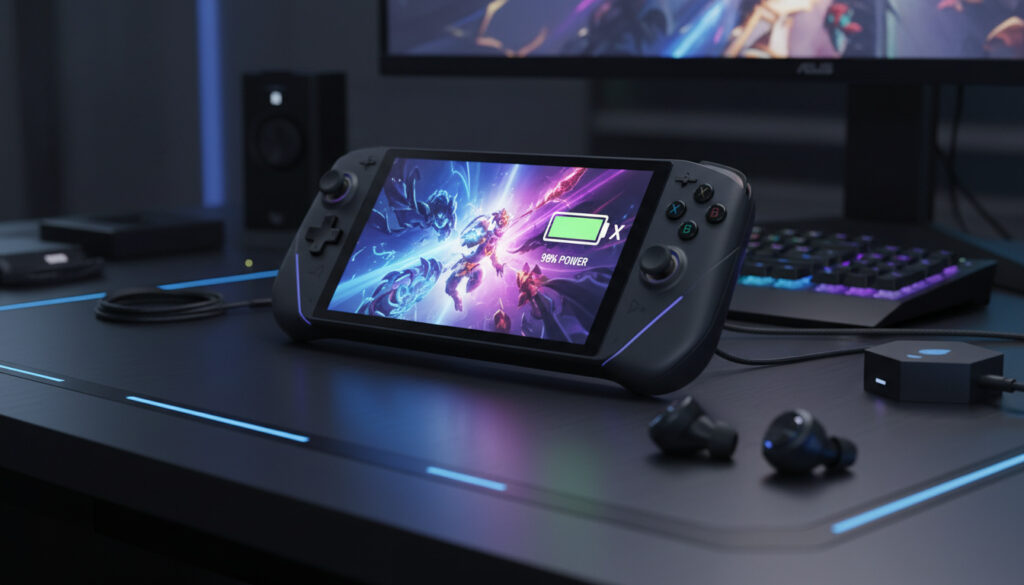
Asus Rog Ally X – Specs, Battery, Price, Release
The ASUS ROG Ally X (2024, model RC72LA) represents a significant evolution in Windows-based handheld gaming devices. Designed as a refined successor to the original ROG Ally, this portable console retains the AMD Ryzen Z1 Extreme processor while introducing substantial hardware upgrades aimed at extending play sessions and improving user experience. The device runs Windows 11 Home, granting native access to PC gaming libraries including Xbox Game Pass, Steam, and Epic Games Store.
Positioned within the growing market of portable gaming PCs, the Ally X differentiates itself through a massive 80Wh battery—double the capacity of its predecessor—and enhanced memory configuration. These changes address the most frequent criticisms of the original model while maintaining compatibility with the Windows ecosystem that distinguishes it from Linux-based competitors.
At $799.99 for the base configuration, ASUS targets enthusiasts seeking desktop-class gaming in a handheld form factor. The device promises to bridge the gap between mobile convenience and PC performance, though questions remain regarding real-world battery endurance under varying workload conditions.
What is the ASUS ROG Ally X?
- The 80Wh battery provides roughly double the capacity of the original Ally, enabling multi-hour AAA gameplay without AC power.
- 24GB of dual-channel LPDDR5X-7500 memory allows seamless switching between games and background applications.
- Standard M.2 2280 SSD form factor replaces the proprietary size of the original, simplifying storage upgrades up to 2TB.
- Windows 11 Home installation provides native compatibility with Xbox Game Pass, PC Game Pass, and traditional Win32 applications.
- Redesigned 0.15mm fan blades increase airflow by 10% compared to previous thermal solutions.
- The 7-inch 120Hz display supports AMD FreeSync Premium for tear-free gaming at variable refresh rates.
- Full PC architecture enables emulation of retro consoles through high-end stable performance.
| Feature | Specification |
|---|---|
| Processor | AMD Ryzen Z1 Extreme (8 cores/16 threads, up to 5.1 GHz) |
| Graphics | AMD Radeon Graphics (RDNA 3, 12 CUs, up to 8.6 Teraflops) |
| Memory | 24GB LPDDR5X-7500 (dual-channel) |
| Storage | 1TB or 2TB M.2 2280 NVMe SSD (user-upgradeable) |
| Display | 7-inch FHD 1920×1080, 120Hz, 500 nits, 100% sRGB |
| Battery | 80Wh lithium-ion |
| TDP Range | 9-30W (Silent/Performance/Turbo modes) |
| Operating System | Windows 11 Home |
| Dimensions | Approximately 11.5 x 4.8 x 2 inches |
| Weight | Approximately 1.58 pounds |
| Connectivity | USB4 Type-C, USB 3.2 Gen 2 Type-C, 3.5mm audio |
| Base Price | $799.99 |
Full specifications are available through ASUS official product pages.
ASUS ROG Ally X Specs and Key Features
The hardware configuration of the ROG Ally X centers on balancing thermal efficiency with processing power. ASUS official specifications confirm the device utilizes the same AMD Ryzen Z1 Extreme found in the original Ally, but pairs it with faster memory and improved thermal management to sustain higher performance for longer durations.
Processing Architecture and Graphics
The Ryzen Z1 Extreme utilizes Zen 4 architecture manufactured on a 4nm process, delivering eight cores and sixteen threads with boost clocks reaching 5.1 GHz. Integrated RDNA 3 graphics provide twelve compute units operating at up to 2.7 GHz, yielding approximately 8.6 Teraflops of computational power. This configuration supports variable TDP settings ranging from 9W in Silent mode to 30W when connected to AC power in Turbo mode.
Memory and Storage Configuration
Unlike the original model’s 16GB configuration, the Ally X ships with 24GB of LPDDR5X-7500 memory arranged in dual-channel mode. This expansion proves particularly beneficial for emulation and multitasking scenarios where system RAM often becomes a constraint. Storage options include 1TB or 2TB variants using the standard M.2 2280 form factor, allowing users to upgrade drives without proprietary adapter requirements.
The 80Wh battery represents the most substantial physical upgrade, providing approximately double the energy capacity of the original ROG Ally. This allows the device to maintain Turbo mode performance for significantly longer periods before requiring AC power.
Display Technology
The 7-inch IPS panel maintains a 1920×1080 resolution with a 16:9 aspect ratio, supporting 120Hz refresh rates and AMD FreeSync Premium certification. Peak brightness reaches 500 nits with 100% sRGB color coverage, while Gorilla Glass Victus provides surface protection. The touchscreen supports ten-point capacitive input for Windows navigation.
Thermal Design and Ports
Cooling improvements include 0.15mm fan blades that are thinner than those in the original model, increasing airflow by 10% according to ASUS technical documentation. The port selection comprises one USB4 Type-C port compatible with Thunderbolt 4, DisplayPort 1.4, and Power Delivery 3.0, alongside a USB 3.2 Gen 2 Type-C port and a 3.5mm audio jack.
ASUS ROG Ally X Release Date and Price
ASUS eStore listings establish the $799.99 price point for the base model, with a 2TB configuration (RC72LA-ALLYX.Z1X2TB) available at premium pricing. The device launched in 2024 following Computex showcase events, with pre-orders and retail availability commencing in the summer quarter.
Launch Timeline and Availability
ASUS unveiled the Ally X during Computex 2024, positioning it as a mid-year hardware refresh. Retail channels began accepting pre-orders shortly after announcement, with stock availability varying by region. The device ships through official ASUS channels and authorized retailers, with buyers advised to verify warranty terms through official sources.
Pricing and Configuration Options
The standard $799.99 configuration includes 1TB of SSD storage, while the upgraded 2TB variant commands additional cost. Both configurations maintain identical processor, memory, and display specifications. Consumers monitoring hardware expenditures alongside checking IRS $1390 Payment November 2025 – Fact Check and Updates for financial planning purposes should note the premium positioning of this device.
ROG Ally X Improvements and Comparisons
Hands-on analysis reveals the Ally X addresses specific limitations of the original model while positioning itself against Valve’s Steam Deck and Lenovo’s Legion Go. The improvements focus on endurance, expandability, and ergonomic refinement rather than raw processing upgrades.
Upgrades Over the Original ROG Ally
The original ROG Ally shipped with a approximately 40Wh battery and 16GB RAM, limiting portable play to shorter sessions. The Ally X doubles battery capacity to 80Wh and increases RAM to 24GB LPDDR5X. Storage transitions from a proprietary M.2 2230 format to standard 2280, enabling easier upgrades. Thinner fans and redesigned internal layouts accommodate these larger components without excessive bulk increases.
The additional 8GB of system memory proves particularly beneficial for emulation workflows and background application management, allowing users to maintain browser tabs or communication software while gaming without performance degradation.
Comparison with Steam Deck
While the Steam Deck runs Linux-based SteamOS, the Ally X utilizes Windows 11, providing immediate compatibility with Xbox Game Pass and PC storefronts without Proton translation layers. The 120Hz display exceeds the Steam Deck OLED’s 90Hz maximum, though Valve’s integrated software optimizations often yield better battery efficiency per watt. The Ally X offers higher peak brightness at 500 nits compared to the standard Steam Deck’s 400 nits. For a detailed comparison of the ASUS ROG Ally X’s specifications and release information, check out $ounces in a cup.
Ergonomics and Portability Trade-offs
User reports indicate comfortable grips designed for extended sessions, though the device remains bulky compared to Nintendo Switch or mobile phones. Review measurements suggest dimensions approximately 11.5 x 4.8 x 2 inches with a weight around 1.58 pounds, making it unsuitable for standard pockets but manageable for travel bags.
The increased battery capacity contributes to additional weight compared to ultra-portable devices. Users seeking pocketable gaming solutions may find the form factor compromises mobility for endurance, particularly when compared to smaller Android handhelds.
When Did the ROG Ally X Launch?
-
Computex 2024:ASUS unveils the ROG Ally X alongside technical specifications and pricing details. Source: ASUS official site
-
Summer 2024:Pre-orders open through ASUS eStore and authorized retail partners, with initial stock allocation beginning.
-
Q3 2024:Retail availability expands to major electronics retailers, with ongoing stock fluctuations based on regional demand.
-
Present:Continued availability through official channels with 1TB and 2TB configuration options.
What Information Remains Uncertain?
| Established Specifications | Variables and Uncertainties |
|---|---|
|
|
How Does the ROG Ally X Fit Into the Handheld Market?
The device occupies a distinct position as a premium Windows handheld, contrasting with Linux-optimized competitors. While analyzing hardware statistics similar to those found in the Washington Nationals vs Atlanta Braves Match Player Stats – Box Score, Highlights & Key Plays, consumers must evaluate whether the Windows ecosystem justifies the price premium over closed systems.
Targeted primarily at PC gamers with existing Steam or Xbox libraries, the Ally X eliminates the compatibility barriers that Linux handhelds present for certain anti-cheat systems and niche applications. However, this flexibility requires users to navigate Windows update cycles and driver management typically absent from console-like experiences.
What Do Official Sources Confirm?
The 80Wh battery doubles capacity for extended gaming sessions, while redesigned thermal solutions accommodate increased power demands without proportional noise increases.
— ASUS Technical Documentation
Official specifications provided by ASUS ROG division verify the hardware configurations detailed in retail listings. The company emphasizes the shift to standard M.2 2280 storage as a user-requested feature improving long-term device viability.
Should You Consider the ROG Ally X?
The ASUS ROG Ally X presents a compelling option for users prioritizing battery life and Windows compatibility in a handheld form factor. The $799.99 entry price positions it as a premium device, but the combination of 24GB RAM, 80Wh battery, and upgradeable storage addresses critical limitations of the original model. For gamers embedded in the Windows ecosystem seeking portable access to PC Game Pass and Steam libraries, the hardware refinements justify the investment over the first-generation Ally.
Frequently Asked Questions
Does the ROG Ally X support Xbox Game Pass?
Yes, running Windows 11 Home allows native installation of the Xbox app and PC Game Pass, enabling cloud and local game streaming without compatibility layers.
Can users upgrade the storage on the ROG Ally X?
The device uses a standard M.2 2280 NVMe SSD form factor, allowing users to replace drives with aftermarket options up to 2TB without proprietary adapters.
What is the refresh rate of the ROG Ally X display?
The 7-inch IPS touchscreen supports 120Hz refresh rates with AMD FreeSync Premium, 7ms response time, and 500 nits peak brightness.
Is the ROG Ally X suitable for retro game emulation?
The Z1 Extreme processor and 24GB RAM provide high-end stable performance for emulation of older consoles through Windows-based emulation software.
What USB connectivity does the ROG Ally X offer?
The device includes one USB4 Type-C port (Thunderbolt 4 compliant) and one USB 3.2 Gen 2 Type-C port, both supporting DisplayPort and Power Delivery.
How does the battery compare to the original ROG Ally?
The 80Wh battery doubles the capacity of the original Ally’s approximately 40Wh cell, significantly extending playtime in Performance and Turbo modes.
What cooling improvements feature in the Ally X?
Thinner 0.15mm fan blades increase airflow by 10% compared to the original model, supporting the larger battery while managing thermal output.
More related posts
 Soccer Store Near Me: Best Shops in Ireland (2026)
 Patrick Dempsey Movies and TV Shows: Complete Guide
 Best Camera for Photography 2026: Top Picks for Every Budget
 Best Ice Cream Near Me: Top Picks for Diabetics & IBS
 Super Mario Bros Movie 2: Sequel, LGBTQ & Streaming
 What Time is Super Bowl LX? Kickoff, Halftime & Global Times
 Best Universities in USA: Top Rankings, Hardest & Easiest Colleges
