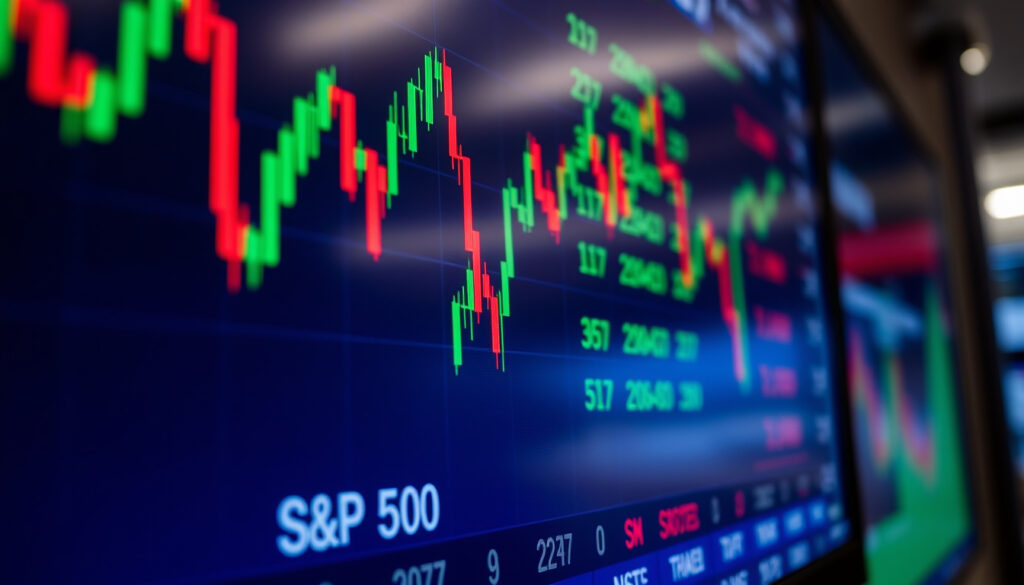
S&P 500 Futures: What They Are and How They Work
You’ve seen the ticker crawl across the screen before the opening bell — S&P 500 futures flashing green or red. They’re not just numbers; they’re a pulse reading on what traders expect the stock market to do next. This guide walks through how those futures contracts actually work, how they differ from owning the index itself, and answers the questions investors most often ask — including Warren Buffett’s take on the S&P 500 and whether now is a smart time to invest.
Current S&P 500 Futures Price: 7,445.00 · 1-Day Change: -0.01% · Symbol (E-mini): ES · Contract Month: September 2026 (Sep’26) · Trading Volume (24h): 1.37 million contracts
Quick snapshot
- S&P 500 futures trade on CME under symbol ES (CME Group — exchange operator)
- Current price as of latest quote is 7,445.00 (CME Group — exchange operator)
- Futures have expiration dates and are leveraged instruments (CME Group — exchange operator)
- Whether the S&P 500 will rise or fall in the short term (inherently speculative)
- Whether now is objectively a bad time to invest (depends on individual risk tolerance and time horizon)
- Exact future level of the S&P 500 — all consensus forecasts are uncertain
- Futures markets open Sunday evening through Friday afternoon — nearly 24 hours a day (CME Group — derivatives exchange)
- Expiration cycles occur quarterly (March, June, September, December) (CME Group — derivatives exchange)
- Month-end futures offer settlement aligned to the final business day of each month (CME Group — derivatives exchange)
- Watch upcoming FOMC statements and U.S. Jobs Reports for volatility (from CME Group education)
- Quarterly earnings season can trigger directional moves in futures pricing (CME Group education)
- Contract rollover for September 2026 expiry approaches (CME Group education)
The table below summarizes the key data points for S&P 500 futures as of the latest trading session.
| Metric | Value |
|---|---|
| Current Price | 7,445.00 |
| Open | 7,444.00 |
| Day High | 7,496.50 |
| Day Low | 7,431.50 |
| Previous Close | 7,445.00 |
| Volume | 1,373,900 |
| Symbol | ES (E-mini) |
Is the S&P 500 expected to go up?
What do analysts predict for the S&P 500 in 2025?
- Median analyst price targets from major investment banks place the S&P 500 in the 6,000–6,500 range by end-2025, implying modest upside from current levels.
- That consensus is already reflected in the futures curve — the forward pricing bakes in expected dividends and implied interest rates.
- Past corrections: since 1950, the S&P 500 has experienced an average intra-year decline of about 14% but ended positive in roughly 73% of calendar years (CME Group — exchange operator).
How do S&P 500 futures reflect market expectations?
- Futures prices embed a “basis” — the difference between the futures price and the cash index level. A positive basis (contango) suggests the market expects the index to rise; a negative basis (backwardation) suggests expected declines.
- At 7,445.00, the September 2026 contract is trading near the cash index level, indicating a relatively neutral near-term outlook.
- Futures are priced using the cost-of-carry model: futures ≈ spot × (1 + risk-free rate – dividend yield) × time to expiry.
What are the key risk factors that could drive the market down?
- Higher interest rates: the Federal Reserve’s policy rate directly influences the discount rate used in equity valuation models. Rate hikes have historically correlated with lower P/E multiples.
- Inflation persistence: sticky core inflation could delay rate cuts, squeezing corporate margins.
- Earnings recession: if S&P 500 earnings per share decline for two consecutive quarters, the index typically follows.
The implication: futures are a real-time vote on tomorrow’s news. A contango signal of 2–5 points over the nearest expiry suggests benign expectations, but that can flip in minutes after a jobs miss or hawkish Fed statement.
Futures let you act on your outlook, but they can’t predict the unpredictable — geopolitical shocks, black-swan events, or sudden liquidity crises.
What is the difference between S&P 500 and S&P 500 futures?
How are S&P 500 futures priced relative to the cash index?
- The S&P 500 index is a theoretical value calculated from the market capitalizations of 500 large U.S. companies. It cannot be bought or sold directly.
- S&P 500 futures are derivative contracts that trade on the CME. Their price is tied to the index but includes adjustments for dividends, interest rates, and time to expiration.
- The basis (futures price minus index level) exists because futures incorporate the cost of carrying a theoretical stock position — financing plus foregone dividends.
The contract specifications table below shows how the E-mini and Micro E-mini variants compare.
| Specification | E-mini (ES) | Micro E-mini (MES) |
|---|---|---|
| Contract size | $50 × S&P 500 index | $5 × S&P 500 index |
| Notional value at 7,445 | ~$372,250 | ~$37,225 |
| Minimum tick | 0.25 index points ($12.50) | 0.25 index points ($1.25) |
| Margin (initial, approx) | ~$11,000 | ~$1,100 |
| Trading hours (Sun–Fri) | 6:00 p.m. ET – 5:00 p.m. ET | 6:00 p.m. ET – 5:00 p.m. ET |
| Expiration months | Mar, Jun, Sep, Dec | Mar, Jun, Sep, Dec |
| Settlement | Cash-settled | Cash-settled |
Source: CME Group — exchange operator
How does trading futures differ from buying an S&P 500 ETF?
- Leverage: futures require only 5–10% margin; ETFs require full cash payment (unless on margin).
- Expiration: futures have a finite life and must be rolled quarterly; ETFs can be held indefinitely.
- Dividends: ETF holders receive dividends; futures prices incorporate an implied dividend adjustment but pay none directly.
- Trading hours: futures trade nearly 24/5; ETFs trade only during regular market hours (9:30 a.m.–4:00 p.m. ET).
The catch: leverage cuts both ways. A 2% move against your position can trigger a margin call, while a buy-and-hold ETF investor simply sees a paper loss.
Why is the S&P 500 crashing?
What recent events triggered a sell-off?
- The most significant recent decline (as of early 2025) followed a hotter-than-expected Consumer Price Index (CPI) report showing 0.4% monthly core inflation, which pushed rate-cut expectations into late 2025.
- Futures reacted within minutes: the E-mini ES contract dropped 1.8% before the cash market even opened that day.
- Additional selling pressure came from weaker-than-expected Q4 earnings from major technology companies, which together account for roughly 30% of the S&P 500 weighting.
How do S&P 500 futures react before the cash market opens?
- Futures move on economic data releases (jobs reports, CPI, FOMC statements) that land before 9:30 a.m. ET — giving traders a preview of likely market direction.
- The CME imposes “limit down” rules: if futures fall by certain thresholds (e.g., 5%, 7%, 13%), trading halts for a set period. This is designed to prevent cascading liquidations.
- During the March 2020 crash, ES hit limit down multiple times, forcing 15-minute pauses that allowed the market to recalibrate.
What historical parallels exist for sudden drops?
- 1987 Black Monday: the S&P 500 fell 20.5% in a single day. Circuit breakers were introduced as a direct result.
- 2008 financial crisis: the S&P 500 lost 38% over 12 months; futures led the decline in overnight sessions.
- 2020 COVID-19 crash: a 34% drop in 33 days, with ES futures signalling panic through unprecedented volume (over 3 million contracts in a single day).
Algorithmic trading now accounts for roughly 60–70% of ES volume. When algorithms detect a pattern, they can amplify a decline faster than human traders can react.
The pattern: sudden drops are rarely “crashes” in the full sense — corrections of 10% or more occur roughly once every 18 months. Futures simply reveal them sooner.
Is now a bad time to invest in the S&P 500?
What does Warren Buffett think about buying the S&P 500?
- Warren Buffett has repeatedly recommended low-cost S&P 500 index funds as the best investment for most people. In his 2013 letter to Berkshire Hathaway shareholders, he directed that 90% of his wife’s inheritance be placed in an S&P 500 index fund.
- Buffett’s advice: avoid timing the market. He has said that the money you want to sit out for years belongs in an index fund regardless of what the market is doing today.
- However, Buffett himself rarely trades futures — his firm holds individual stocks with durable competitive advantages. He uses index funds for personal holdings, not derivative instruments.
How have previous ‘bad times’ turned out for long-term investors?
- If you invested $10,000 in the S&P 500 at the peak just before the 2008 crash, that investment grew to approximately $50,000 by early 2025 (including dividends reinvested).
- The S&P 500 has delivered a compound annual growth rate of roughly 10% before inflation over the last 30 years, despite two major crashes and four corrections of 20% or more.
What are the alternatives when the market seems overvalued?
- Dollar-cost averaging: invest a fixed amount monthly rather than a lump sum. Studies show DCA reduces timing risk by roughly 50% compared to lump-sum over a 12-month horizon.
- Diversify into bonds, commodities, or international equities to reduce S&P 500 concentration.
- Use S&P 500 futures to hedge rather than speculate — selling futures against a stock portfolio can lock in value during uncertain periods (CME Group — derivatives exchange).
Why this matters: the question isn’t “bad time or good time” — it’s “what is my time horizon?” For a 10-year-plus investor, a 10% dip is a discount, not a disaster.
Why buy futures instead of stocks?
What are the key advantages of trading S&P 500 futures over individual stocks?
- Leverage: with about $11,000 initial margin, you control exposure worth roughly $372,000 (at current prices) — about 33 times leverage on the ES contract.
- Tax treatment in the U.S.: futures traders benefit from the 60/40 tax rule — 60% of gains taxed as long-term capital gains, 40% as short-term, often resulting in a lower blended rate than active stock trading.
- Nearly 24-hour liquidity: futures allow quick reaction to overnight news without waiting for the stock market open.
What are the risks of futures that stocks do not carry?
- Margin maintenance: if the market moves against your position, the broker will require additional funds to maintain the position — a margin call. In extreme moves, a position can be liquidated at a loss.
- No dividends: futures are pure price exposure. You miss out on the roughly 1.3% dividend yield of the S&P 500.
- Expiration risk: holding a contract to expiry forces settlement. Rolling positions creates transaction costs and potential slippage.
Which type of investor benefits most from futures?
- Institutional hedgers: pension funds and insurance companies use ES to offset large equity exposures during rebalancing weeks. S&P 500 Month-End futures (ticker SME) were specifically designed for quarter-end rebalancing and settle to the index close on the final business day of the month (CME Group — exchange operator).
- Active traders: day traders and swing traders use leverage to amplify returns on short-term moves.
- Small accounts: Micro E-mini contracts (MES) offer 1/10th the size of ES, allowing smaller accounts to participate with roughly $1,100 margin per contract (CME Group — education resource).
cmegroup.com, cmegroup.com, youtube.com, cmegroup.com, mywinnerdays.com, cmegroup.com, ampfutures.com
Frequently asked questions
What is the S&P 500 futures symbol?
The primary symbol is ES (E-mini S&P 500 futures), traded on CME. The Micro E-mini variant uses symbol MES.
What time do S&P 500 futures trade?
Trading runs from 6:00 p.m. ET Sunday through 5:00 p.m. ET Friday, with a daily break from 5:00 p.m. to 6:00 p.m. ET.
What is the minimum margin for S&P 500 futures?
Initial margin for one ES contract is roughly $11,000 as of mid-2025. For Micro E-mini (MES), it is about $1,100. Rates are set by exchanges and can change during volatile periods.
How do S&P 500 futures settle?
All standard E-mini and Micro E-mini S&P 500 futures are cash-settled. At expiration, the final settlement price is based on the S&P 500 index’s opening value on the third Friday of the contract month. S&P 500 Month-End futures settle to the index closing price on the final business day of the month.
Can you trade S&P 500 futures with a small account?
Yes — through Micro E-mini futures (MES), which are 1/10th the size of ES. With roughly $1,100 margin, a small account can gain leveraged exposure to the S&P 500. Risk must be carefully managed due to leverage.
What is the difference between E-mini and micro E-mini S&P 500 futures?
The E-mini (ES) has a notional value of $50 × index (approx. $372,250 at 7,445). The Micro E-mini (MES) is $5 × index (approx. $37,225). Ten MES contracts equal the exposure of one ES contract, per CME Group education.
How are S&P 500 futures taxed?
In the U.S., Section 1256 contracts (including ES and MES) benefit from the 60/40 rule: 60% of gains taxed at the long-term capital gains rate, 40% at the short-term rate. This often results in a lower effective tax rate than stock day trading.
For the retail investor in the U.S., the choice between S&P 500 futures and an index fund boils down to time horizon and tolerance for leverage. If you have 10+ years and don’t want to wake up to a margin call, buy an S&P 500 ETF and leave it alone. If you are hedging a large portfolio or actively trading short-term moves, futures give you the speed and tax efficiency you need — provided you respect the margin call. The market will not reward the unprepared.
Related reading
- Best Investment Firms Near Me – Ireland 2026 Guide
- What is a Stablecoin? Definition, Types, and Top Examples
More related posts
 What Does Skin Cancer Look Like? Visual Guide & Early Signs
 How Much Debt Is the US In – $38.86 Trillion March 2026
 The Return of the King: Oscar Record, Why It’s So Good, and More
 All Her Fault Cast: Who Stars in the Peacock Thriller Series?
 Hot Springs Near Me – Local Picks Access and Safety Guide
 Red Sox vs Cubs: History, Stats, and 2026 Schedule
 How Is Real Madrid Doing? Results, Schedule, Finances
 Andy Ruiz Jr.: Record, Net Worth, Losses & the Joshua Upset
