How to Make Caramelized Onions Step by Step
There’s something magical about a heap of sliced onions transforming into a jammy, golden pile of sweetness, and anyone who’s spent forty minutes at the stove knows the payoff is immense. One large onion yields about half a cup of caramelized onions — an 80% volume reduction The Modern Proper (cooking site).
Average cooking time: 30–60 minutes ·
Volume reduction: One large onion yields ~½ cup caramelized (≈80% reduction) ·
Natural sugar increase: Onions contain 4–6% sugar by weight; caramelization concentrates it 4–5× ·
Ideal pH for browning: pH 5.5–6.5 (add a pinch of baking soda to speed browning)
Quick snapshot
- Low heat is essential Savory Experiments (cooking blog)
- Salt helps draw out moisture Love and Lemons (vegetarian blog)
- No added sugar needed Tasting Table (food site)
- Whether baking soda affects final flavor significantly My Eclectic Bites (recipe blog)
- Exact time savings of oven method vs stovetop (My Eclectic Bites (recipe blog))
- Caramelization takes 30–60 minutes stovetop Trial and Eater (recipe site)
- Oven method: 2–3 hours at 375°F (Trial and Eater (recipe site))
- Slow cooker: 8–10 hours on low (Trial and Eater (recipe site))
- Use on burgers, pizzas, dips, soups, and more
- Store in fridge for up to 1 week or freeze for months
Four key data points worth knowing before you begin.
| Label | Value |
|---|---|
| Onion type most used | Yellow onions (sweet or Spanish) |
| Fat temperature limit | Butter smoke point ~350°F; olive oil ~410°F |
| Volume after cooking | 1 large onion → ~½ cup caramelized |
| Natural sugar content | 4–6% by weight; concentrated to ~20% after caramelization |
How do you caramelize onions?
What type of onions to use
- Yellow or Spanish onions are the top choice because they balance sweetness and savory depth Love and Lemons (vegetarian blog).
- Sweet onions (Vidalia, Walla Walla) contain more sugar and brown faster.
- Red onions work but turn a less appealing purple-gray.
How long does it take
- Stovetop: 30–60 minutes over medium-low heat Trial and Eater (recipe site).
- Oven: 2–3 hours at 375°F.
- Slow cooker: 8–10 hours on low.
Step-by-step stovetop method
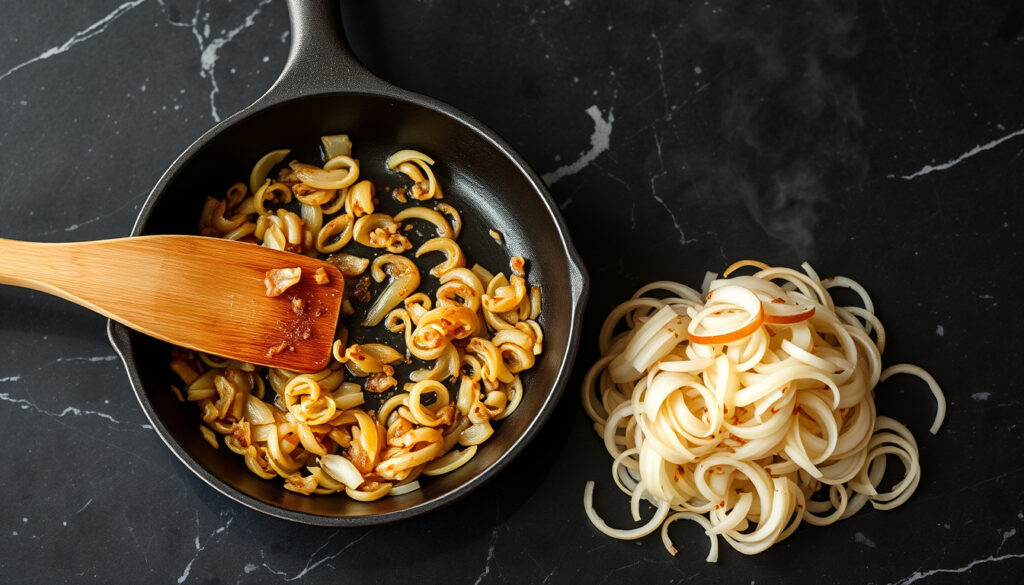
- Slice 3–4 large yellow onions into ¼-inch half-moons.
- Heat 2 tablespoons of butter and 1 tablespoon of olive oil in a large skillet over medium-low heat.
- Add onions and a pinch of salt; stir to coat. Savory Experiments (cooking blog).
- Cook, stirring every 5–10 minutes, for 30–60 minutes, until deep golden brown.
- Deglaze with 2–3 tablespoons of water, broth, or wine whenever the pan looks dry.
Low heat and patience beat high heat every time. The sugars in onions — 4–6% by weight — need time to break down and recombine into the deep brown compounds that define caramelization.
The implication: rushing with high heat scorches the outside before the inside softens, leaving raw-tasting onions with bitter black spots The Kitchn (home cooking resource).
Do you caramelize onions with butter or oil?
Butter vs oil flavor and smoke point
- Butter adds rich flavor but burns at around 350°F Savory Experiments (cooking blog).
- Olive oil has a smoke point of about 410°F, making it more forgiving.
- Hybrid butter+oil approach combines flavor and stability Everything Erica (food blog).
Four common fat options, one key trade-off: flavor depth versus heat tolerance.
| Fat | Smoke point | Flavor impact | Best for |
|---|---|---|---|
| Butter | ~350°F | Rich, nutty | Low-and-slow method (risk of burning) |
| Olive oil | ~410°F | Fruity, mild | Standard stovetop method |
| Ghee | ~485°F | Nutty, clarified | High-heat shortcuts |
| Butter+olive oil | ~380°F (blend) | Buttery with safety margin | Best of both worlds |
The trade-off: using butter alone requires the lowest heat and most attention. Olive oil is more forgiving, but a hybrid gives you the butter taste without the char risk.
Can you use ghee or bacon fat?
- Ghee’s high smoke point (485°F) makes it excellent for quick methods The Modern Proper (cooking site).
- Bacon fat adds smoky flavor but may overpower the onions.
Is there a trick to caramelizing onions?
Do you need sugar?
- No — onions naturally contain 4–6% sugar by weight, enough to brown deeply over time Tasting Table (food site).
- Added sugar can speed browning but risks burning if not carefully managed.
Gordon Ramsay’s method (balsamic vinegar and brown sugar)
- Chef Ramsay adds a splash of balsamic vinegar and a teaspoon of brown sugar near the end for depth and shine.
- “The acidity cuts the sweetness and the sugar helps it caramelize even further,” he explains in his YouTube tutorial.
Using baking soda to speed caramelization
- ½ teaspoon of baking soda per 4 onions raises the pH and accelerates the Maillard reaction My Eclectic Bites (recipe blog).
- Downside: can turn onions mushy and alter the flavor.
Baking soda cuts the cooking time dramatically, but if you’re after the classic jammy texture with distinct soft strands, you’ll lose it. The trade-off is real: speed vs. texture.
The implication: if texture matters, avoid baking soda.
How to make caramelized onions quickly
High-heat method (with careful monitoring)
- Use medium heat and stir constantly; finished in 15–20 minutes.
- Higher risk of burning; deglaze often with water Allrecipes (recipe site).
Slow cooker or Instant Pot method
- Slow cooker: 8–10 hours on low yields deeply caramelized onions without attention.
- Instant Pot: pressure-cook for 30 minutes, then sauté with lid off to reduce liquid.
Caramelized onions in 15 minutes using baking soda
- Add ¼ teaspoon baking soda per 2 large onions; cook over medium-high heat with constant stirring.
- Onions brown in 10–15 minutes but become very soft Allrecipes (recipe site).
The pattern: each shortcut trades time for texture control.
What are common mistakes when caramelizing onions?
Overcrowding the pan
- Onions must be in a single layer to caramelize properly; overcrowding traps steam and prevents browning The Kitchn (home cooking resource).
Using too high heat
- High heat burns the sugars before they melt, creating bitter black spots instead of even golden color.
Not stirring often enough
- Stir every 5–10 minutes for even cooking and to prevent sticking.
Adding sugar too early
- Added sugar lowers the browning temperature and can cause burning before the onions are fully soft Tasting Table (food site).
Each mistake compounds: overcrowding leads to steaming, which leads to a longer cook time, which tempts you to crank the heat — exactly the sequence that ends in burnt, bitter onions. Break the chain by keeping the pan sparse, the heat low, and the spoon moving.
The takeaway: avoid the chain of mistakes by controlling heat and pan space.
Clarity check
Confirmed facts
- Low heat is essential
- Salt helps draw out moisture
- No added sugar needed
- Stirring prevents burning
What’s unclear
- Whether baking soda affects final flavor significantly
- Exact time savings of oven method vs stovetop
“You don’t need sugar — just time. Onions already have plenty of their own.”
Savory Experiments (cooking blog)
“If you’re using a nonstick pan, you can get away with less fat, but cast iron gives you better fond — the browned bits that add flavor.”
Trial and Eater (recipe site)
For anyone who’s ever ended up with scorched onions and a burned pan, the lesson is clear: respect the slow melt. Caramelization is not a high-speed chase; it’s a patient simmer. Stick to medium-low heat, stir regularly, and let the onions do the work. The reward is a sweet, silky, umami-packed ingredient that elevates everything it touches.
Related reading: 5 mistakes to avoid when making caramelized onions · Caramelized Onions
reddit.com, healthylittlevittles.com, themodernproper.com, facebook.com
If you want to nail the technique every time, check out this step-by-step guide for caramelized onions that includes Gordon Ramsay’s trick and common mistakes to avoid.
Frequently asked questions
Are caramelized onions good for diabetics?
Yes, in moderation. Caramelized onions have a higher sugar concentration than raw onions, but the overall sugar content per serving is still low — about 2–3 grams per tablespoon. The fiber from the onions slows absorption. However, if you add sugar during cooking, the carb count goes up.
Can you freeze caramelized onions?
Absolutely. Let them cool, then portion into freezer bags or containers. They keep for up to 3 months. Thaw in the fridge overnight and reheat gently.
How to slice onions for caramelizing?
Slice into even ¼-inch half-moons. Thicker slices take longer, thinner slices burn faster. Consistency is key for even cooking.
What is the best pan for caramelizing onions?
Cast iron or stainless steel are best because they produce fond (browned bits) that add flavor. Nonstick is easier to clean but doesn’t build fond. A wide skillet helps spread the onions in a single layer.
Do caramelized onions taste sweet?
Yes — their natural sugars caramelize, producing a deep, rich sweetness that’s savory and complex.
Can you caramelize onions in the oven?
Yes. Spread sliced onions on a baking sheet with oil and roast at 375°F for 2–3 hours, stirring every 30 minutes. This requires less active attention.
More related posts
 Real Madrid vs Osasuna Lineups: Predicted Starting XI
 What Is the Keto Diet? Beginner’s Guide to Ketogenic Diet
 One Word Hello Greeting: Cool, Gen Z & Classy Ways
 Farmer Wants a Wife Season 3 Couples Update & News
 SC State vs South Carolina: History, Payment & Rankings
 May 14 2025 Social Security Payment: Schedule & Amounts
 How to Silence Notifications on iPhone – iOS 18 Focus Guide
 When Does Implantation Bleeding Occur? Timing, Signs & Testing
