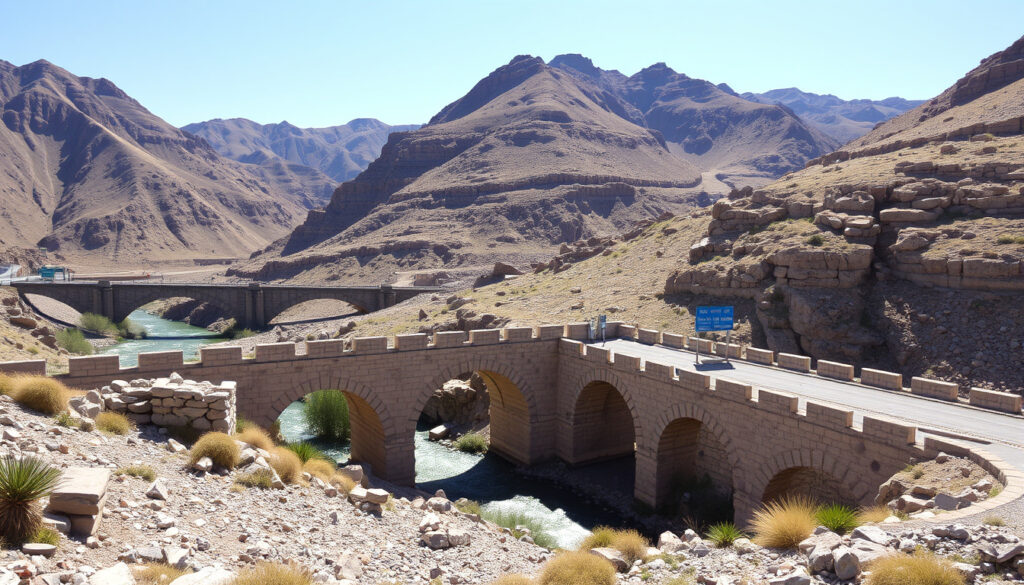
Armenia–Iran Border: Length, Crossings, and Travel Tips
The sole land crossing between Armenia and Iran at Agarak/Norduz remained open in March 2026 despite regional conflict disruption, but with altered operations and heightened security advisories.
Border Length: 44 km (27 mi) | Main Crossing: Nordouz (Iran) / Meghri (Armenia) | Current Status: Open (with security advisories) | Recent Development: New bridge construction underway (2026)
Geography
- Border length: 44 km (Konrad-Adenauer-Stiftung)
- Runs along the Arax River (Konrad-Adenauer-Stiftung)
- Tripoints with Azerbaijan’s Nakhchivan region
Crossing Points
- Main crossing: Nordouz (Iran) / Meghri (Armenia) (Konrad-Adenauer-Stiftung)
- Second crossing: Agarak (planned new bridge) (Konrad-Adenauer-Stiftung)
- Vehicles and pedestrians allowed
Safety
- Current travel advisory: Level 2 (exercise increased caution) (U.S. Virtual Embassy Iran)
- Border zone monitored by Iranian and Armenian authorities
- Recent air strikes near border in 2025 (Armenian Weekly)
History
- Border established after Treaty of Turkmenchay (1828) (Konrad-Adenauer-Stiftung)
- Soviet era saw limited crossing
- Post-1991 independence, both countries maintain open border
| Attribute | Detail | Source |
|---|---|---|
| Border Length | 44 km (27 mi) | Konrad-Adenauer-Stiftung |
| Number of Border Crossings | 1 active (Nordouz/Meghri); 1 under construction (Agarak) | Konrad-Adenauer-Stiftung |
| Year Established | 1828 (Treaty of Turkmenchay) | Konrad-Adenauer-Stiftung |
| Current Status | Open, with security advisories | U.S. Virtual Embassy Iran |
| Primary Use | Trade, travel, Iranian diaspora evacuation route | Armenian Weekly |
Is the border between Armenia and Iran open?
Current border status
The Agarak/Norduz crossing was reported open for passenger traffic on March 5, 2026, after a disruption on March 4, 2026, according to the Armenian Weekly. On March 18, 2026, the U.S. Virtual Embassy Iran confirmed the border was open and taxis were available onward to Yerevan. The State Revenue Committee of Armenia stated on March 21, 2026 that the crossing operated normally, with daily monitoring of people and cargo (ARKA News Agency).
Entry restrictions
Travelers need valid visas for both countries. The crossing is open to pedestrians and vehicles. During the 2026 disruptions, cargo movement was limited while passenger traffic resumed (Armenian Weekly).
Security advisories
The U.S. Virtual Embassy Iran advises exercise increased caution due to regional tensions. Travelers should monitor local news and register with their embassy.
Bottom line: The border remained open through March 2026 despite Iranian disruptions, and official Armenian statements confirm normal operations as of March 21.
Is Armenia friendly with Iran?
Diplomatic relations
Armenia and Iran maintain friendly diplomatic relations, characterized by regular high-level visits and cooperation. Both countries share concerns over regional security.
Trade and energy ties
Economic cooperation includes an energy swap agreement and a joint hydroelectric project. The border crossing at Agarak is a key corridor for bilateral trade. In early March 2026, 400 to 450 trucks crossed daily, according to Armenian customs (Armenian Life).
Cultural exchanges
Armenian communities in Iran and cultural exchanges date back centuries, reinforcing mutual understanding.
“The Armenian government is prepared to facilitate the evacuation of foreign citizens from Iran through Armenian territory via the Agarak border crossing.” – Armenian Weekly, March 2, 2026
The pattern shows that Armenia has positioned itself as a humanitarian corridor, which reinforces bilateral trust.
How are Armenians treated in Iran?
Legal status of Armenian minority
Armenians are recognized as a religious minority in Iran, with guaranteed rights under the constitution. They have their own schools and churches.
Religious and cultural rights
The community is concentrated in Tehran and Isfahan. They are free to practice Christianity, and Armenian-language media is permitted.
Representation in Iranian parliament
Armenians hold two reserved seats in the Iranian parliament (Majlis), one for the northern and one for the southern Armenian community.
Was Armenia ever part of Iran?
Historical periods of Persian rule
Parts of historic Armenia were under Persian rule at various times, most notably during the Achaemenid, Parthian, and Safavid empires.
Impact on Armenian culture
Persian architectural and linguistic influences are present in Armenian heritage, particularly in areas like artsakh.
Modern border demarcation
The Treaty of Turkmenchay (1828) established the modern border between the Russian Empire and Persia, dividing historic Armenian lands (Konrad-Adenauer-Stiftung).
Is it safe to go to Armenia right now?
General safety in Armenia
Armenia is generally safe for travelers. Crime rates are low, and the country is welcoming to tourists.
Border region security
The border region with Iran has heightened security due to regional tensions. On March 4, 2026, a drone strike raised fears of war spillover, affecting the checkpoint (Armenian Weekly). However, the Armenian State Revenue Committee stated on March 21 that the situation is under control (ARKA News Agency).
Travel advisories from US and other governments
The U.S. Virtual Embassy Iran advises caution and recommends registering with the embassy. Other governments issue similar advisories.
Warning: While the border is open, Iranian authorities interrupted automated control systems in March 2026, causing delays for cargo trucks (Armenian Life). Travelers should expect longer wait times.
Tip: Check the latest OSAC alerts before planning a crossing. Carry copies of your passport and visa.
What remains unclear
- Exact current status of the new bridge construction
- Whether the border will close in the near future
- Number of daily crossings during normal times
Confirmed facts
- Border length is 44 km (Konrad-Adenauer-Stiftung)
- Main crossing is Nordouz (Iran) / Meghri (Armenia) (Konrad-Adenauer-Stiftung)
- Armenia and Iran have diplomatic relations
- Armenians are a recognized minority in Iran
Related reading: Armenia–Iran border reopened after March 2026 disruption · Drone strike raises fears of Iran war spillover affecting border crossing
en.wikipedia.org, adept.travel, lostwithpurpose.com, azatutyun.am, youtube.com, iranintl.com
Frequently Asked Questions
What is the Nakhchivan exclave and how does it relate to the border?
Nakhchivan is an exclave of Azerbaijan bordering Armenia and Iran. It does not directly border the Armenia–Iran crossing but influences regional geopolitics.
Can I cross the Armenia–Iran border with a rental car?
Rental cars may be permitted with proper documentation. Check with your rental agency and border authorities in advance. Restrictions may apply during emergencies.
Are there any visa-free agreements between Armenia and Iran?
No, both countries require visas for most nationalities. However, Iran offers visa on arrival at some airports. Overland crossing still requires a pre-arranged visa.
What is the nearest major city to the border on each side?
On the Armenian side, Meghri is the closest town; Kapan is the largest nearby city. On the Iranian side, Jolfa is the nearest town, with Tabriz about 150 km away.
Is the border monitored by international observers?
No permanent international observation mission exists. Border security is managed solely by Armenian and Iranian authorities.
How long does it take to cross the border at Nordouz?
Under normal conditions, 1–2 hours. During crises, wait times can exceed 5 hours. The March 2026 disruptions caused additional delays for cargo.
Are there any restrictions on goods crossing the border?
Standard customs restrictions apply. During the 2026 Iranian system disruptions, cargo was temporarily limited while passenger traffic continued.
More related posts
 iPhone 16 Pro Size – Dimensions, Weight & Comparisons
 What Is the 25th Amendment? Simple Guide to Sections
 Slip and Fall Lawyers – Hiring, Costs and Claims Guide
 Athletic Club vs Man United: History, Identity & 2025 Clash
 Flying Dutchman In-N-Out: What It Is and How to Order
 Sunrise on the Reaping Cast – Confirmed Actors and Rumors
 FedEx Jobs Near Me: Warehouse, Part-Time & Full-Time Jobs
