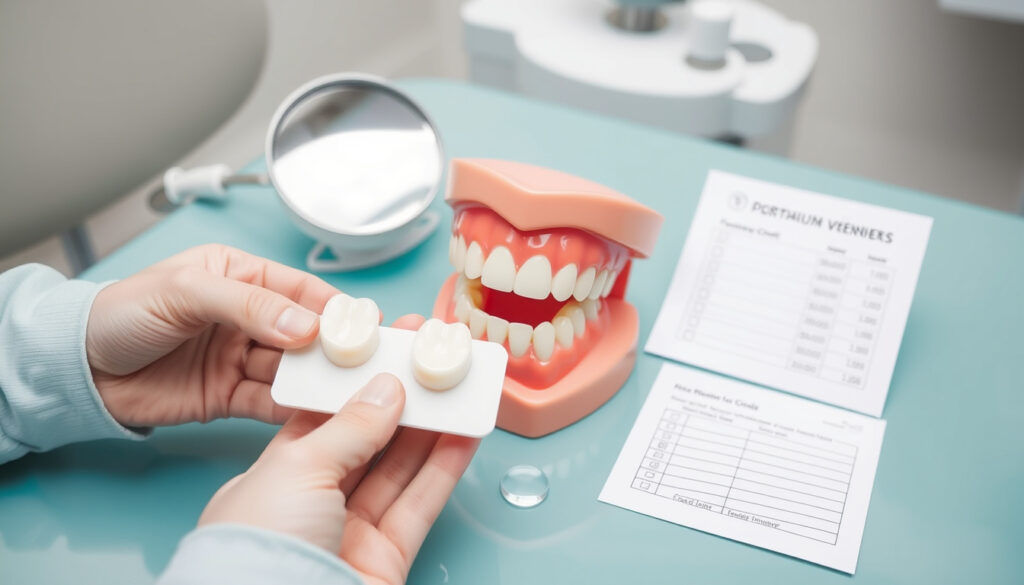
How Much Are Veneers? Cost, Lifespan & Pros/Cons Guide
Hiding your smile in photos is a common frustration, and veneers promise a fast fix—but the cost in Dublin ranges from €275 to €1,200 per tooth. The decision goes far beyond upfront costs.
Composite veneer cost per tooth: €275–€325 ·
Porcelain veneer cost per tooth: €550–€1,200 ·
Typical veneer lifespan: 10–15 years ·
Veneers for full smile makeover: 6–10 teeth ·
Pain level during procedure: Minimal (local anesthesia)
Quick snapshot
- Composite veneers cost €275–€325 per tooth (3Dental, Dublin clinic)
- Porcelain veneers cost €550–€1,200 per tooth (WhatClinic, dental directory)
- Porcelain veneers typically last 10–15 years (Dental Care Ireland, dental network)
- Exact lifespan depends heavily on personal habits and care routine.
- Cost varies significantly by clinic and case complexity.
- Long-term effects after 20+ years are not well documented.
- Pricing has remained stable in Ireland through 2025–2026, with no major shifts reported.
- Book a consultation with a dentist for a personalised quote and suitability assessment.
Here’s a quick overview of the essential numbers.
| Fact | Value |
|---|---|
| Composite veneer cost per tooth | €275–€325 |
| Porcelain veneer cost per tooth | €550–€1,200 |
| Typical lifespan | 10–15 years (porcelain), 5–7 years (composite) |
| Number of visits | 2–3 |
| Anesthesia | Local anesthesia used |
How much is a full set of veneers in Ireland?
What is the cost per tooth for composite veneers?
- Composite veneers at 3Dental (Dublin clinic) are priced at €275–€325 per tooth.
- Love To Smile (Dublin practice) offers composite bonding from €180 for one tooth and €160 per tooth for two or more.
- Vhi (health insurer in Ireland) notes composite bonding often runs €250–€400 per tooth.
What is the cost per tooth for porcelain veneers?
- Porcelain veneers at 3Dental start from about €600 per tooth.
- WhatClinic (dental booking platform) lists a typical range of €495–€1,500+ per tooth.
- Vhi states porcelain veneers generally start from about €800 per tooth.
Are there payment plans available?
Some Irish clinics offer payment plans for treatments over €1,000. 3Dental is one example where you can spread the cost. Always ask about financing options during your consultation.
Choosing composite over porcelain saves you money today but means you’ll likely need replacements in 5–7 years—adding up to more visits and eventual costs similar to one porcelain set.
The pattern: upfront cost vs. long-term cost. Composite is cheaper to start but requires more frequent replacement; porcelain costs more initially but can last twice as long. The real price depends on how many years you plan to keep the smile.
How long do veneers typically last?
What happens after 20 years of veneers?
- Dental Care Ireland (dental network) says porcelain veneers generally last 10–15 years with proper care.
- Pembroke Dental (Dublin clinic) also confirms porcelain veneers last between 10 and 15 years.
- Vhi gives a slightly narrower range of 7–12 years depending on oral habits.
- Composite veneers typically last 5–7 years (3Dental) or 3–5 years per Dental Care Ireland.
Can porcelain veneers last 30 years?
30 years is not a realistic expectation for most patients. While individual cases can exceed 15 years with exceptionally careful maintenance and good oral health, the general consensus among Irish clinics points to 10–15 years as the reliable benchmark. After 20 years, veneers often need replacement due to wear, staining, or marginal breakdown.
The implication: lifespan is not fixed. Your brushing habits, diet, and whether you grind your teeth can push the needle by several years. Treat veneers as a long-term investment in maintenance, not a one-time fix.
Are veneers painful to get?
What is the pain level during veneer placement?
The procedure is minimally invasive. 3Dental notes that local anesthesia is used, so you won’t feel pain during the enamel preparation or bonding. Some patients report mild sensitivity for a few days after placement, but overall pain is rated low.
Is anesthesia used?
Yes, local anesthesia is standard for porcelain veneers because the dentist must shave down a thin layer of enamel. Composite veneers may not always require anesthesia. Always ask your dentist what to expect.
Patients with sensitive teeth or who skip the numbing step may feel discomfort. Most Irish clinics err on the side of comfort, so speak up if you’re anxious.
The takeaway: pain should not be the deciding factor. The real discomfort is more about the cost and the irreversibility of enamel removal.
What is the downside to veneers?
What happens to teeth under veneers?
- Teeth under veneers can still decay if plaque builds up at the margins.
- Because enamel is removed (0.3–0.5 mm for porcelain), the procedure is irreversible—you will need veneers or restorations for life.
- The risk of gum disease and decay increases if cleaning between teeth is neglected.
Are there limitations on what you can eat with veneers?
Yes. Biting into hard foods like apples, hard nuts, or ice is not recommended. Veneers can chip or crack under excessive force. You should also avoid using your teeth as tools (opening bottles, biting nails).
Upsides
- Immediate aesthetic improvement.
- Stain-resistant (porcelain).
- Can correct multiple issues in one treatment.
Downsides
- Irreversible enamel removal.
- Risk of decay under veneer.
- Cannot whiten veneers; natural teeth may yellow.
- Costly to replace.
The catch: the perfect smile comes with a permanent trade-off. Once you go down the veneer path, you’re committed to maintenance for the rest of your life.
What is the 4 8 10 rule for veneers?
How many veneers are needed for a smile makeover?
- 4 veneers: for minor adjustments to front teeth (e.g., slight discolouration or small gaps).
- 8 veneers: for a moderate smile makeover, covering the top front eight teeth.
- 10 veneers: for a full transformation, often from canine to canine (four premolars added).
Can veneers cover yellow teeth?
Veneers can cover discoloured teeth, but natural teeth may still yellow beneath them. If your natural teeth are yellow, it’s recommended to whiten them first before getting veneers to ensure a uniform shade. Once veneers are bonded, you cannot whiten them—any whitening product works only on natural tooth structure.
The pattern: the 4 8 10 rule is a rough guideline, not a strict medical requirement. Your dentist will determine the ideal number based on your facial symmetry, gum line, and your personal goals.
Comparison: Composite vs Porcelain Veneers
Two materials, one decision: composite is cheaper and faster, porcelain is stronger and longer-lasting. The table below shows the trade-offs side by side.
| Feature | Composite Veneers | Porcelain Veneers |
|---|---|---|
| Cost per tooth (Ireland) | €180–€400 | €495–€1,500+ |
| Lifespan | 3–7 years | 10–15 years |
| Number of visits | 1–2 | 2–3 |
| Enamel removal | Minimal or none | 0.3–0.5 mm |
| Repairability | Repairable in one visit | Must be remade |
| Stain resistance | Moderate (prone to staining) | High |
| Strength (resistance to chipping) | Lower, more prone to chipping | Higher |
| Long-term cost (15 years) | €1,080–€2,400 (2–4 replacements) | €495–€1,500 (one set) |
Why this matters: the true cost of composite isn’t the first placement—it’s the repeating cycle of replacements. For patients who plan to keep their smile for decades, porcelain often comes out cheaper per year.
“Composite veneers are a less invasive option, but porcelain veneers are stronger and last longer.”
– 3Dental (Dublin clinic)
“Porcelain veneers are made in a dental laboratory and require more time and expertise, which is why they cost more.”
– Dental Care Ireland (dental network)
“E-max veneers offer natural results that last 10–15 years, starting from €550 per tooth.”
Confirmed facts vs what’s still unclear
- Composite veneers cost €275–€325 per tooth at 3Dental.
- Porcelain veneers cost €550–€1,200 per tooth at WhatClinic.
- Porcelain veneers typically last 10–15 years (Dental Care Ireland).
- Local anesthesia ensures minimal pain during placement.
- Exact lifespan depends on oral habits and care.
- Cost can vary based on clinic and case complexity.
- Long-term effects after 20+ years are not well documented.
For patients in Ireland, the decision isn’t just about price—it’s about lifestyle and how long you intend to keep the result. Composite gives you a quick, affordable entry, but the maintenance gets expensive. Porcelain asks for a bigger upfront investment but rewards you with durability and less hassle over time. For the patient who can afford the initial cost and wants the longest-lasting solution, porcelain is the clearer choice. For the patient on a tighter budget or unsure about committing to permanent enamel removal, composite offers a reversible (ish) step into veneers.
If you experience any dental issues, such as Swollen Gum Around One Tooth – Causes and Treatment, our guide can help. Also, for general health awareness, What Does Skin Cancer Look Like? Visual Guide & Early Signs provides early warning signs.
gentledentistry.online, perthcitydental.com.au, youtube.com, viennadentalexperts.com, whitesmiledental.ie
For a detailed breakdown of composite and porcelain veneer costs at Irish clinics like 3Dental, you can explore the pricing guide that covers both composite and porcelain options.
Frequently asked questions
How much does a single veneer cost?
In Ireland, a single composite veneer costs €180–€400, while a single porcelain veneer costs €495–€1,500+ depending on the clinic and material.
Can I get veneers on the NHS?
The NHS does not operate in Ireland. You’ll need to see a private dentist. Some clinics offer payment plans to spread the cost.
Do veneers require special care?
Brush twice daily, floss carefully around the edges, and avoid hard foods. Regular dental check-ups are essential to monitor margins and gum health.
Can I whiten veneers?
No. Whitening products only work on natural teeth. If you whiten before getting veneers, the dentist can match the shade accordingly. Once bonded, veneers stay their original colour.
How long does the whole procedure take?
Composite veneers can often be done in one visit (about 1–2 hours per tooth). Porcelain veneers require two visits: one for preparation and impressions, a second for bonding 2–3 weeks later.
Are there alternatives to veneers?
Yes, alternatives include composite bonding (similar to composite veneers but without enamel removal), crowns, orthodontics, and teeth whitening. A consultation helps determine which is suitable.
Will my insurance cover veneers?
Most health insurance plans in Ireland consider veneers a cosmetic procedure and do not cover them. Check with your provider for any exceptions, especially if veneers are needed for tooth damage.
More related posts
 Foundation TV Series: Season 4 Renewal & Worth Watching Guide
 Sahasra Slope Skyview Tower Guide: Unlock & Cave
 Where to Watch Kung Fu Panda: Streaming Guide for 2025
 Edge Computing in IoT: Definition, Examples & Benefits
 James, Viscount Severn: Age, Titles, Family and Royal Life
 Call Verizon Customer Service – Official Numbers, Hours & Tips
 Kairat vs Real Madrid 2025: Score, History & Facts
 Sound of Music Cast Then and Now: Who’s Alive 2023
