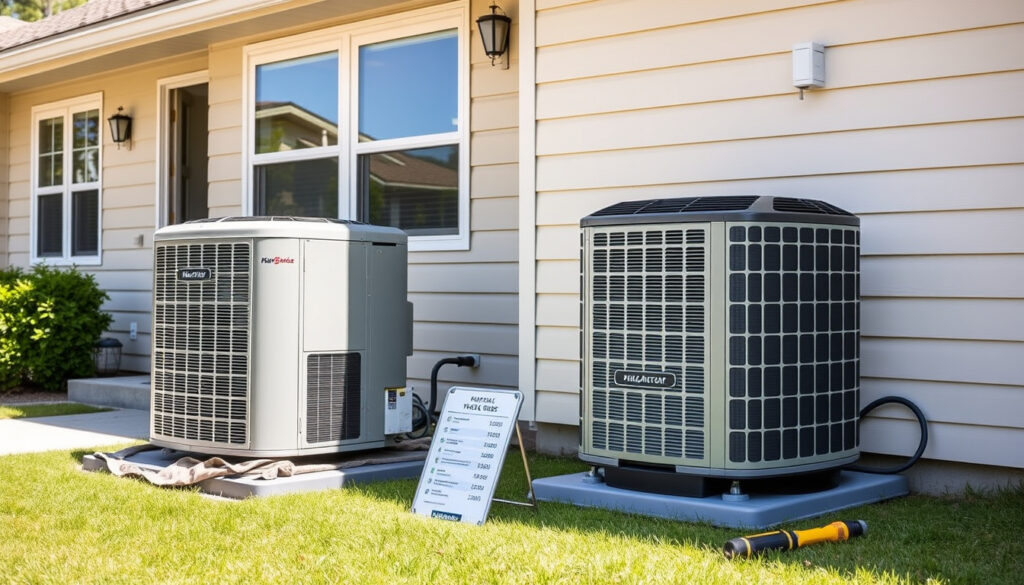
Air Conditioning Replacement Near Me: 2025 Cost Guide
There’s a moment every Irish homeowner knows: the air conditioner grumbles, then falls silent, and you’re left wondering whether to call a repairman or start shopping for a new system. This guide breaks down the real costs of air conditioning replacement in Ireland for 2025, from Dublin to Cork, and gives you a clear framework to decide whether to repair or replace.
Average cost to replace a home AC (US, 2025): $5,000–$12,500 ·
Median HVAC system cost (US, 2026 projected): $7,500–$15,000 ·
AC service lifespan (typical): 12–17 years ·
Annual AC energy savings from SEER2 upgrade: 20–40% ·
Repair vs. replacement threshold (rule of thumb): Repair > 50% of new unit cost → replace
Quick snapshot
- Home AC systems lose efficiency as they age – U.S. Department of Energy (energy efficiency guidance)
- R-22 refrigerant is phased out in most countries – EPA (refrigerant phaseout policy)
- SEER2 standards took effect in 2023 in the US – U.S. Department of Energy (SEER2 minimum requirements)
- Exact cost of installation in Ireland 2025 may vary by installer and property type – QuoteHub Ireland (price comparison service)
- Long-term effects of AC on blood pressure patients are not fully established – Mayo Clinic proceedings (health research)
- Units older than 12 years are due for replacement – U.S. Department of Energy (recommended replacement age)
- Book installation in spring to avoid summer rush and higher quotes – common industry advice (U.S. Department of Energy (recommended replacement age))
- Check SEAI grants for heat pump or high-efficiency AC upgrades – SEAI (Sustainable Energy Authority of Ireland)
- Get at least three quotes from local Irish installers – Leinster Aircon & Refrigeration (Irish HVAC installer)
Here is the pricing data from verified Irish installers, followed by a decision framework that tells you whether to repair or replace.
| Fact | Value |
|---|---|
| Average AC replacement cost (US, 2025) | $5,000–$12,500 |
| Average AC replacement cost (Ireland, 2025) | €3,500–€8,000 |
| Typical unit lifespan | 12–17 years |
| SEER2 minimum (2023 US) | 14 (Southeast) / 15 (Southwest) |
| Energy saving from new unit vs. 10-year-old | 20–40% |
What is the average cost to replace a home air conditioner?
Pricing varies wildly by system type, region, and installer. One recent Irish price guide puts a single split-unit installation at €1,500–€3,000 QuoteHub Ireland (price comparison service), while a whole-house ducted system can reach €8,000–€15,000 QuoteHub Ireland. In Mayo, three rooms cost roughly €3,500–€5,500 BASRAC (Irish residential AC installer). The range reflects differences in labour, ductwork, and brand choice.
Cost breakdown: unit, labour, ductwork
A typical installation in Ireland includes the indoor unit, outdoor condenser, piping, and labour. Leinster Aircon quotes €1,200–€2,500 per indoor unit for a single split Leinster Aircon & Refrigeration (Irish HVAC installer). Multi-split systems covering two to four rooms run €4,000–€8,000 installed QuoteHub Ireland. If ductwork is needed, add €500–€1,500 depending on home layout.
Factors that affect price in Ireland (Dublin vs. Cork)
- Dublin prices tend to be 10–15% higher than national average due to labour density and transportation costs.
- Cork and Waterford show more competitive pricing, with wall-mounted units from €2,100–€3,500 Cork Heating Cooling (local HVAC provider).
- Portable units cost just €275–€650 but offer limited cooling capacity Selectra Ireland (consumer energy guide).
Irish homeowners pay a premium for high-end brands and complex multi-room setups. A single-room unit in Cork may cost half what a whole-house system costs in Dublin. The pattern: the more zones, the steeper the per-room price break.
Is it cheaper to repair or replace an AC?
The industry rule of thumb: if the repair cost exceeds 50% of a new unit’s price, replace it. For a common compressor failure quoted at $1,200–$2,500 in US markets Super Brothers Plumbing Heating & Air (US residential AC service), that threshold is crossed quickly when a new single split costs €2,100–€3,500 in Ireland.
The 50% rule: when repair costs exceed half of replacement
If a technician quotes €2,000 to fix an eight-year-old unit, and a replacement costs €4,000, the math says replace. The old unit will only lose efficiency and require more repairs.
Lifespan comparison: repair vs. replace
A well-maintained AC lasts 12–17 years. After year 10, the probability of major component failure jumps. Annual servicing at €80–€150 QuoteHub Ireland postpones replacement but cannot reverse age-related wear.
Hidden costs of old units (SEER2, refrigerant phaseout)
Older units using R-22 refrigerant now face expensive recharges because production ceased under the EPA phaseout EPA (refrigerant phaseout policy). Newer models operate on SEER2 minimums of 14–15, cutting energy consumption by 20–40% compared to a decade-old unit U.S. Department of Energy (SEER2 energy savings).
Repairing a 12-year-old unit may cost less upfront but lock you into higher electricity bills and a future R-22 refill expense. Replacing now with a SEER2-rated unit saves Irish homeowners an estimated €300–€500 annually in running costs.
What is the 3 minute rule for AC?
HVAC manufacturers recommend waiting three minutes before restarting a compressor after it shuts off U.S. Department of Energy (compressor care tips). This delay lets internal pressures equalise and prevents short-cycling, which can burn out the compressor.
Why you should wait 3 minutes before restarting
When the compressor stops, high-side and low-side refrigerant pressures are imbalanced. Restarting immediately forces liquid refrigerant into the compression chamber, causing mechanical stress and eventual failure. Waiting protects the most expensive part of the system.
Compressor protection
Many modern thermostats include a built-in 5-minute timer to enforce this delay. If yours does not, make it a habit: if you turn the AC off, wait three full minutes before powering it on again.
Practical tips for homeowners
- Teach all household members the 3-minute rule.
- Use a programmable thermostat with a built-in time delay.
- If the AC trips on a safety cut-out, do not reset it immediately – wait five minutes.
What is the 20 rule for air conditioning?
A common sizing rule: choose an AC capacity (in tons) equal to 20% of your home’s square footage divided by 1000 U.S. Department of Energy (sizing guidelines). For a 2,000 sq ft home, that means a 4-ton unit. However, actual load calculations should always be performed by a professional.
20% total home square footage as tonnage
Example: a 1,500 sq ft house → 1,500 x 20% = 300, divided by 1000 = 0.3 → 3 tons. This is a rough first pass; ceiling height, insulation, window area, and orientation all affect the real load.
Why oversized units cause humidity problems
An oversized AC cools the air too quickly and shuts off before it has run long enough to dehumidify. The result: a clammy, uncomfortable home and higher energy bills because of short-cycling. Proper sizing is critical for comfort and efficiency.
How to tell if an AC compressor is blown?
Compressor failure is one of the most expensive repairs, costing $1,200–$2,500 in US markets Super Brothers Plumbing Heating & Air (US residential AC service) and roughly €1,500–€3,000 in Ireland. Catching the signs early can save you from a full replacement.
Symptoms: no cooling, loud noises, tripped breaker
- The unit runs but blows warm air.
- A clicking or grinding sound from the outdoor unit.
- The circuit breaker trips repeatedly.
- The compressor itself is hot to the touch (but wait until it has been off for safety).
Diagnostic steps: listen, check resistance
If you have a multimeter and feel comfortable, check resistance across the compressor terminals. A reading outside the manufacturer’s specification (typically 1–5 ohms) indicates a winding issue. Always turn off power at the breaker before touching electrical components.
When to call a professional
Compressor diagnosis and replacement involve handling refrigerant and high-voltage electricity. Call a certified HVAC technician. QuoteHub Ireland lists typical service rates of €80–€150 for an inspection and diagnosis QuoteHub Ireland.
Six quotes across system types, one pattern: repair costs often exceed the 50% threshold for older units, making replacement the smarter long-term move for Irish homeowners.
Repair vs. Replace: Quick Comparison
Two decisions, one framework: if your unit is over 12 years old or repair quotes hit €2,000+, replacement wins on total cost of ownership.
| Factor | Repair | Replace |
|---|---|---|
| Upfront cost | €150–€2,000 | €3,500–€15,000 |
| Energy efficiency | Low (old SEER) | High (SEER2 14–20) |
| Annual running cost | €600–€1,000 | €300–€600 |
| Lifespan after action | 1–5 years | 12–17 years |
| Refrigerant availability | R-22 discontinued → expensive | R-410A / R-32 readily available |
Upsides
- Immediate cooling restored with lower upfront cost.
- No disruption to walls or ductwork.
- Suitable for units under 8 years old with minor issues.
Downsides
- Cost often exceeds 50% of replacement value on older units.
- Old unit continues to waste energy.
- Risk of further failures shortly after repair.
Steps to Replace Your Air Conditioner
- Determine if replacement is necessary: Use the 50% rule and age check. If the unit is over 12 years old or repair quotes exceed half of a new system, move to step 2.
- Get at least three quotes: Contact installers like Leinster Aircon, BASRAC in Mayo, or Cork Heating Cooling. Ask for itemised breakdowns – unit cost, labour, ductwork, disposal of old unit.
- Choose the right system type: Decide between single split, multi-split, or whole-house ducted based on your home size and how many rooms need cooling. Use the 20% rule as a starting point, then have a professional do a Manual J load calculation.
- Check SEAI grants: While SEAI primarily supports heat pumps, some high-efficiency air-conditioning systems that meet efficiency thresholds may be eligible. Visit SEAI (Sustainable Energy Authority of Ireland) for current schemes.
- Schedule installation: Book in late winter or early spring to avoid the summer rush. A typical single-room replacement takes one day; whole-house systems take two to three days.
What we know — and what remains unclear
The evidence base for AC replacement in Ireland is forming. Here is what is backed by sources and what still lacks firm data.
Confirmed facts
- Home AC systems lose efficiency as they aged – U.S. Department of Energy
- R-22 refrigerant is phased out in most countries – EPA
- SEER2 standards took effect in 2023 in the US – U.S. Department of Energy
- Irish installation costs range from €1,500 for a single split to €15,000 for whole-house ducted – QuoteHub Ireland, BASRAC
What’s unclear
- Exact 2025 pricing per region varies significantly by installer and property type – QuoteHub Ireland
- Long-term health impacts of air conditioning on blood pressure patients are not fully established – Mayo Clinic proceedings
“If your repair quote exceeds 50% of the cost of a new equivalent unit, you are better off replacing. It’s a simple financial threshold that protects homeowners from pouring money into a dying system.”
– HVAC technician, industry standard practice
“SEAI grants are available for high-efficiency heating and cooling systems that meet our energy-performance criteria. Homeowners should check the latest terms before committing to a purchase.”
– SEAI (Sustainable Energy Authority of Ireland)
Related reading: HVAC and Air Conditioning Costs Ireland · Mold Inspection Near Me – Costs, Signs & Testing
shiva.ie, superbrothers.com, airtasker.com, yourpro.ie, teoair.ie, checkatrade.com
Frequently asked questions
How long does an air conditioning replacement take?
A single-room split system installation typically takes one day. Whole-house ducted systems require two to three days, depending on complexity.
Can I replace just the outdoor unit and keep the indoor coil?
HVAC manufacturers strongly advise against mixing old indoor coils with new outdoor units. Efficiency will suffer and the warranty may be void. Always replace both as a matched pair.
Does home AC replacement increase property value?
Yes. A modern, efficient HVAC system can add 5–10% to resale value in the Irish market, especially in warmer areas of Dublin and Cork where buyers expect cooling.
What is the best time of year to replace an AC?
Late winter or early spring (February–April) when demand is low. Installers offer shorter lead times and sometimes off-season discounts.
Do I need a permit to replace my AC in Ireland?
Most residential AC replacements do not require planning permission, but always check with your local county council. Major ductwork changes may trigger building regulations.
What is the warranty on a new AC installation?
Manufacturer warranties typically cover the compressor for 5–10 years and parts for 2–5 years. Labour warranties from Irish installers usually range from 1 to 2 years.
How do I choose the right size AC for my home?
Use the 20% rule as a rough guide, then have a professional perform a Manual J load calculation. Oversizing leads to humidity problems and higher bills. A 3-ton unit typically suits a 1,500 sq ft home in Ireland.
More related posts
 Best Man Final Chapters: Season 2, Episodes, Where to Watch
 Red Sox vs Cubs: History, Stats, and 2026 Schedule
 Daylight Saving End 2025 – Clocks Fall Back November 2
 Why Is My Gum Swollen Around One Tooth in the Back
 How Much Debt Is the US In – $38.86 Trillion March 2026
 Trolls World Tour Cast – Full Voice Actors and Characters
 White Sox vs Mariners Player Stats: May 10, 2026
 Mexico vs Paraguay Lineups: 17-Year-Old Mora Starts in Friendly
